
Want to know what a marcaire meal actually is before booking a table in the Vosges? This farmhouse menu, built around tourte, local meat, marcaire potatoes and cheese, comes straight from the life of the herders who worked the high pastures. Here is what it includes, how it connects to the end of the summer grazing season, and where to find it around La Bresse.
A meal born from the marcaires’ way of life
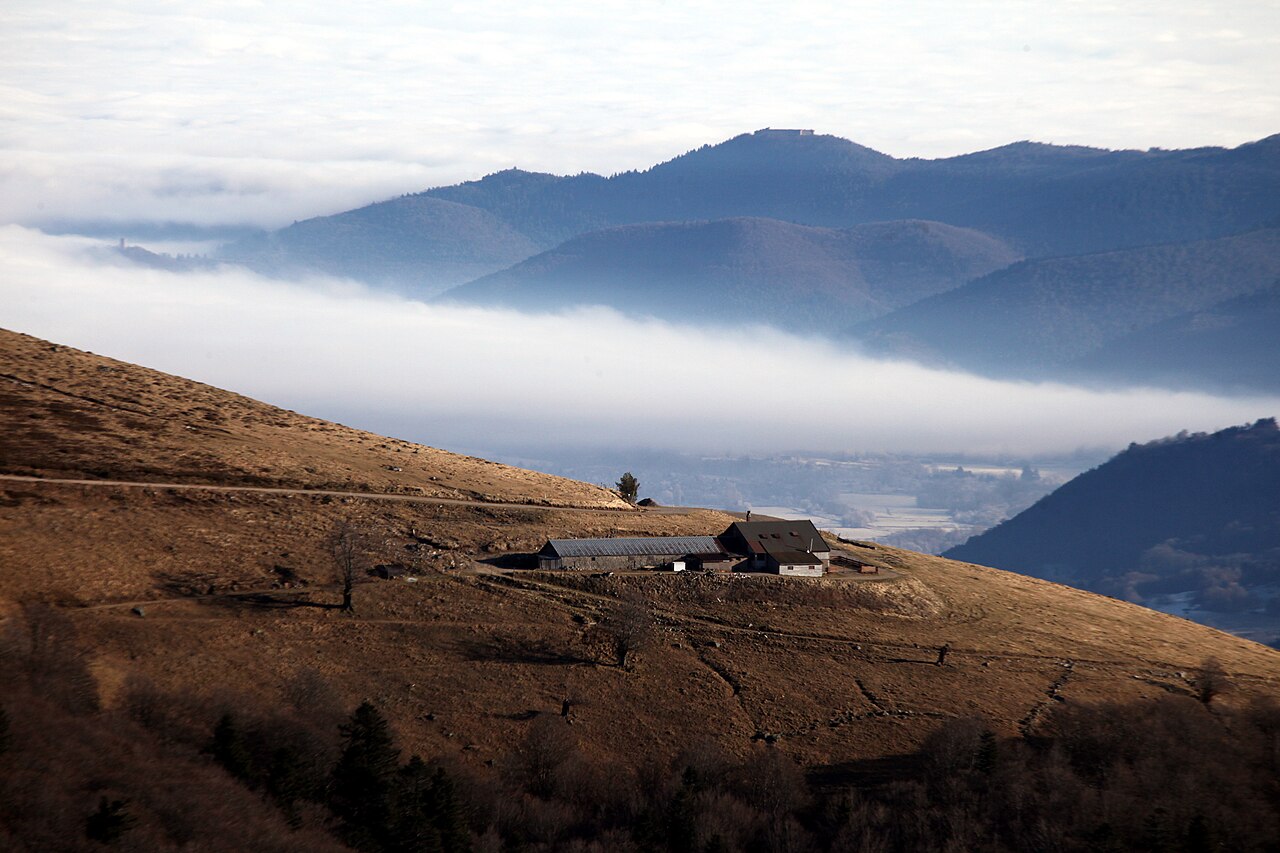
The marcaires were the herder-cheesemakers who took their herds up to the high pastures of the Vosges massif each summer, grazing the animals and making cheese on site. Their cooking, simple and filling, also served to welcome the first hikers crossing these pastures in the late 19th century.
This dual role, farming and hospitality, gave rise to the farm-inns (fermes-auberges). In the Haut-Rhin, the Association des Fermes-Auberges was founded in 1971 by the farmer-innkeepers themselves, backed by the Chamber of Agriculture. It later drew up a charter in 1992, revised in 2001, covering hospitality, produce, the menu and the setting. These farms now maintain more than 3,500 hectares of high pastures, an environment the association describes as a biological entity unique in Europe. For the full list of checked addresses on the Haut-Rhin side and around La Bresse, see our guide to the farm-inns around La Bresse.
What’s on the menu at a marcaire meal?
The menu changes with the farm, the herd and the season, but the structure stays recognizable:
A tourte or a soup opens the meal. Next comes farm meat served with marcaire potatoes, known as roïgabrageldi on the Alsace side. Cheese takes centre stage: farmhouse munster, fromage blanc or tofailles depending on the address. The meal ends with a blueberry tart or a seasonal fruit tart.
Tofailles, potatoes and bacon fried in lard, rank among the oldest dishes of this pasture-hut cooking. Our piece on Vosges tartiflette and tofailles walks through the recipe for making it at home. For cheese, a stop at the Brabant goat farm in La Bresse lets you watch the milking and taste a local product, alongside the munster found on most marcaire menus.
The link with the end of the summer grazing season
The marcaire meal keeps a strong link to the rhythm of the alpine grazing season. Herds go up to the pastures in spring and come back down in September, at the end of the estive. This seasonal pattern explains why several farm-inns and mountain inns across the massif close between late autumn and the following spring. The Auberge de la Chaume de Schmargult, for instance, runs continuous service from late April to early November, before switching to winter access that depends on the chairlift and snow cover.
Booking a marcaire meal in September means catching the end-of-season cooking, while farms are still making the most of summer produce before closing or shifting to their winter pace.
Where to enjoy a marcaire meal near La Bresse
Two addresses on the Route des Crêtes, a few minutes from La Bresse, serve a marcaire meal throughout the season.
The Auberge du Pied du Hohneck, at 1 route des Crêtes in La Bresse, sits about a 5-minute walk from the summit of the Hohneck. The menu includes marcaire meal, choucroute, munster tartiflette and blueberry tart, with set menus starting at 27 euros for an adult and 13 euros for a child. Booking: 03 29 63 11 50.
The Auberge de la Chaume de Schmargult, at 1,200 metres within the La Bresse-Hohneck estate, serves marcaire menu, pork collar, ham hock, tofailles, tourte, fish-pond trout and munster fondue. The two dining rooms seat 120 and the terrace another 50. Booking: 03 29 63 11 49.
For a genuine certified working farm with direct cheese sales, you need to cross the ridge to the Haut-Rhin side: the Ferme-Auberge du Forlet, at Lac du Forlet in Soultzeren, serves the marcaire meal in a glacial cirque, with a final stretch of dirt track worth checking before you head up.
Opening in autumn and winter
Read on 18 October 2026 on the La Bresse Hautes Vosges tourist office listings:
- The Auberge de la Chaume de Schmargult lists daily opening from 24 April to 1 November 2026. In winter, from mid-December to the end of March, you reach it by the Lande chairlift, open from 9 am to 5 pm depending on snow cover.
- The Auberge du Pied du Hohneck states that it is open all year, except annual closures in mid-November and at the end of March.
For both inns, the phone numbers given above let you confirm opening on the day.
Booking and planning your outing
Booking by phone remains the best option, especially at weekends and during school holidays. Ask about the exact access (paved road, dirt track or a final stretch on foot depending on the farm) and flag any dietary needs, since the menu follows what the farm has on hand rather than a fixed set list.
To stretch the local-food day further, a stop at the Ferme du Saichy in La Bresse lets you see the Vosges-breed herd and pick up some AOP farmhouse munster on the way out. For something to drink, the craft breweries around La Bresse make a local blonde beer that pairs well with tourte and tofailles, and the Confiserie Bressaude rounds off the day with a sweet stop before heading home.
See also
- Farm-inns around La Bresse
- Vosges tartiflette and tofailles
- Ferme du Saichy in La Bresse
- Brabant goat farm La Bresse
The 2026 La Bresse guide, ready to download
Access, activities, hikes and useful addresses in one free PDF.
Your details are used only to process this request. Privacy policy (in French).
Free PDF, no newsletter sign-up.
Frequently asked questions
What is a marcaire meal?
It's the traditional menu served at farm-inns in the Vosges: a tourte or soup, farm meat served with marcaire potatoes (roïgabrageldi on the Alsace side), munster or tofailles, then a blueberry tart or seasonal fruit tart. The exact composition depends on the farm and what it produces.
Why is the marcaire meal linked to the end of summer?
The marcaires were the herder-cheesemakers who took their herds up to the high pastures during the summer season. The marcaire meal comes from their cooking and from how they welcomed hikers. The grazing season ends in September, when several farm-inns and mountain inns close until spring.
Where can you eat a marcaire meal near La Bresse?
The Auberge du Pied du Hohneck and the Auberge de la Chaume de Schmargult, both on the Route des Crêtes, serve a marcaire meal. For a genuine certified working farm, head over to the Haut-Rhin side, towards Soultzeren, Le Gaschney or Metzeral.