
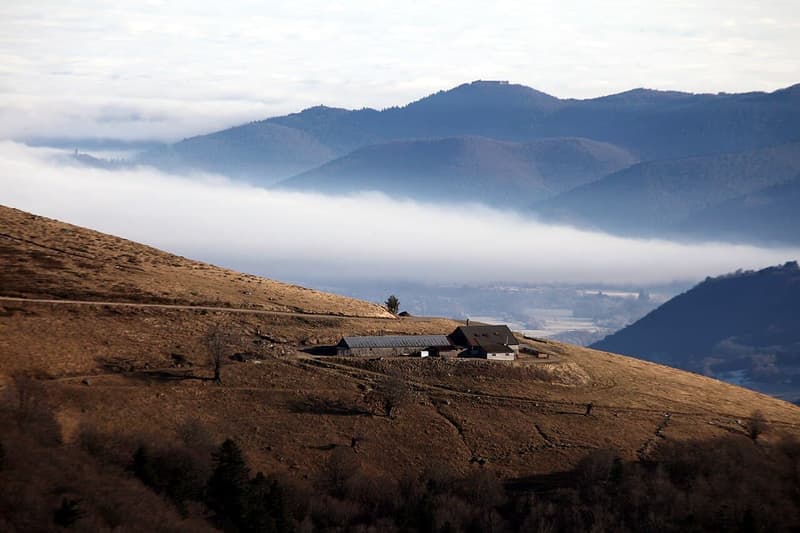
You see the term everywhere in the Vosges and in Alsace, without quite knowing what it covers. A ferme-auberge isn’t a restaurant dressed up as a chalet: it’s a working farm that serves at the table what it produces itself. This guide explains the concept, how it differs from a regular restaurant, how the menu works, and what to check before booking a table.
A Farm First, an Inn Second
The founding principle is a double activity: farming and hospitality. The farmer raises livestock (cows, goats) and turns the milk into cheese, butter, or yoghurt on site. Cured meats are smoked in-house, and some farms grow their own vegetables too. Serving meals comes on top of this main activity, not the other way around.
The tradition goes back to the marcaires, the cowherd-cheesemakers who used to take their herds up to the high Vosges pastures for the summer season. According to the Massif des Vosges website, they were the ones who started welcoming the first hikers over a century ago, a movement that grew with the creation of the Club Vosgien trail network. The Association des Fermes-Auberges du Haut-Rhin, which now oversees most of the labelled establishments, was founded by the farmers themselves in 1971: it now brings together 42 establishments, one of which is still being certified.
This origin explains why a genuine ferme-auberge isn’t just anywhere: it sits on a chaume or an alpine pasture, often at the end of a paved road or after a dirt track, right where the herd grazes in summer.
What Sets a Ferme-Auberge Apart From a Restaurant
Three things concretely set a ferme-auberge apart from an ordinary mountain restaurant.
The produce comes from the farm itself. The charter of the Haut-Rhin association requires farms to prioritise their own produce (meat, cured goods, cheese), with local sourcing for anything else. A restaurant, however good, buys its raw ingredients from outside suppliers.
The menu is often a single set meal. The signature dish is the marcaire menu: soup or a savoury tart, smoked meat with potatoes cooked with onions and bacon, called tofailles on the Vosges side and roïgabrageldi on the Alsace side, farmhouse cheese, then a regional dessert such as bilberry tart or fromage blanc with kirsch. Many ferme-auberges serve it as a fixed menu with no à la carte choice, simply because the kitchen works with whatever the farm produces that day. Others offer a few set formulas, built the same way around their own produce.
Capacity is limited by the farm, not by a business strategy. The dining room is often a converted barn or a room next to the cowshed, with a restricted number of covers. That’s why booking directly by phone is strongly recommended, especially at weekends and during school holidays: unlike a standard restaurant, online booking systems remain rare.
To find out more about the cheese served at the table, our guide to farmhouse munster from the Vosges explains how it differs from an industrial munster.
Prices, Booking, and Common Sense Before Setting Off
There’s no shared price list across every ferme-auberge: each farm sets its own price based on what its marcaire menu includes. The rate gets confirmed directly over the phone when booking, along with access details (a paved road or a dirt track, depending on the farm) and how you can pay, since some remote farms only take cash for lack of a card network.
The Haut-Rhin label also requires an advisory inspection every six years to check the charter is being respected (welcome, produce, menu, setting), according to Alsace Destination Tourisme. It’s a useful marker: a ferme-auberge listed in the association’s official directory has been checked against these criteria, unlike an address that simply has a rustic look.
If you’re after a goat farm to visit before the meal, the same logic applies: produce processed on site, direct sales, and hours tied to the herd’s rhythm rather than standard business hours.
Mountain Inn or Ferme-Auberge: Don’t Mix Them Up
Not every table serving a marcaire-style meal is a ferme-auberge. Some mountain inns serve the same specialities (munster tartiflette, tofailles, bilberry tart) without keeping a herd or producing anything themselves: they cook regional produce they’ve bought in, not necessarily their own. There’s nothing wrong with that, but it’s a different activity, and their tourist listings generally present them as restaurants or inns, not as working farms.
Our selection of verified fermes-auberges around La Bresse breaks down this distinction address by address, with official listings, access details, and booking information for each one, including the one at Gaschney on the GR5.
How to Recognise a Trustworthy Ferme-Auberge
Three checks are enough before making the trip:
- Is the address listed in the official directory of the Association des Fermes-Auberges du Haut-Rhin, or on a tourist office page that explicitly describes it as a working farm?
- Is today’s access confirmed: a dirt track that’s fine by car in good weather can become impassable after rain.
- Are booking and payment clarified over the phone, especially if you’re planning to pay by card.
These three checks help you avoid the most common letdown: arriving at a farm that’s closed, fully booked, or unreachable with the vehicle you brought.
Extending the Discovery of Vosges Produce
A ferme-auberge fits naturally alongside other producer visits during a stay. In La Bresse itself, Ferme du Saichy lets you see a herd of the Vosges breed and buy farmhouse munster outside of a meal. For a family outing with less usual animals, Ferme aux Rennes du Schantzwasen is 30 km away, on the Alsace side. And to end the day on a sweet note, the workshop at Confiserie Bressaude can be visited free of charge in La Bresse.
For drinks, fans of local beer can also stop at one of the craft breweries around La Bresse, another side of the massif’s farm-based and artisanal production.
The 2026 La Bresse guide, ready to download
Access, activities, hikes and useful addresses in one free PDF.
Your details are used only to process this request. Privacy policy (in French).
Free PDF, no newsletter sign-up.
Frequently asked questions
What's the difference between a ferme-auberge and a restaurant?
A ferme-auberge is first and foremost a working farm: the farmer raises the animals, processes the milk, and cooks what's produced there. A restaurant buys its produce from suppliers and doesn't depend on a farming activity. A ferme-auberge often serves a single set menu, whereas a restaurant offers a full menu of choices.
Do you need to book ahead at a ferme-auberge in the Vosges?
Yes, booking by phone directly with the farm is strongly recommended, especially at weekends, on public holidays, and during school holidays. The size of the dining room is limited by the farm itself, not by a business target.
How much does a meal cost at a ferme-auberge?
The price depends on each farm and isn't set by any shared price list: it varies with what the marcaire menu includes (starter, main, cheese, dessert) and with the farm itself. The exact rate is confirmed when you book.