
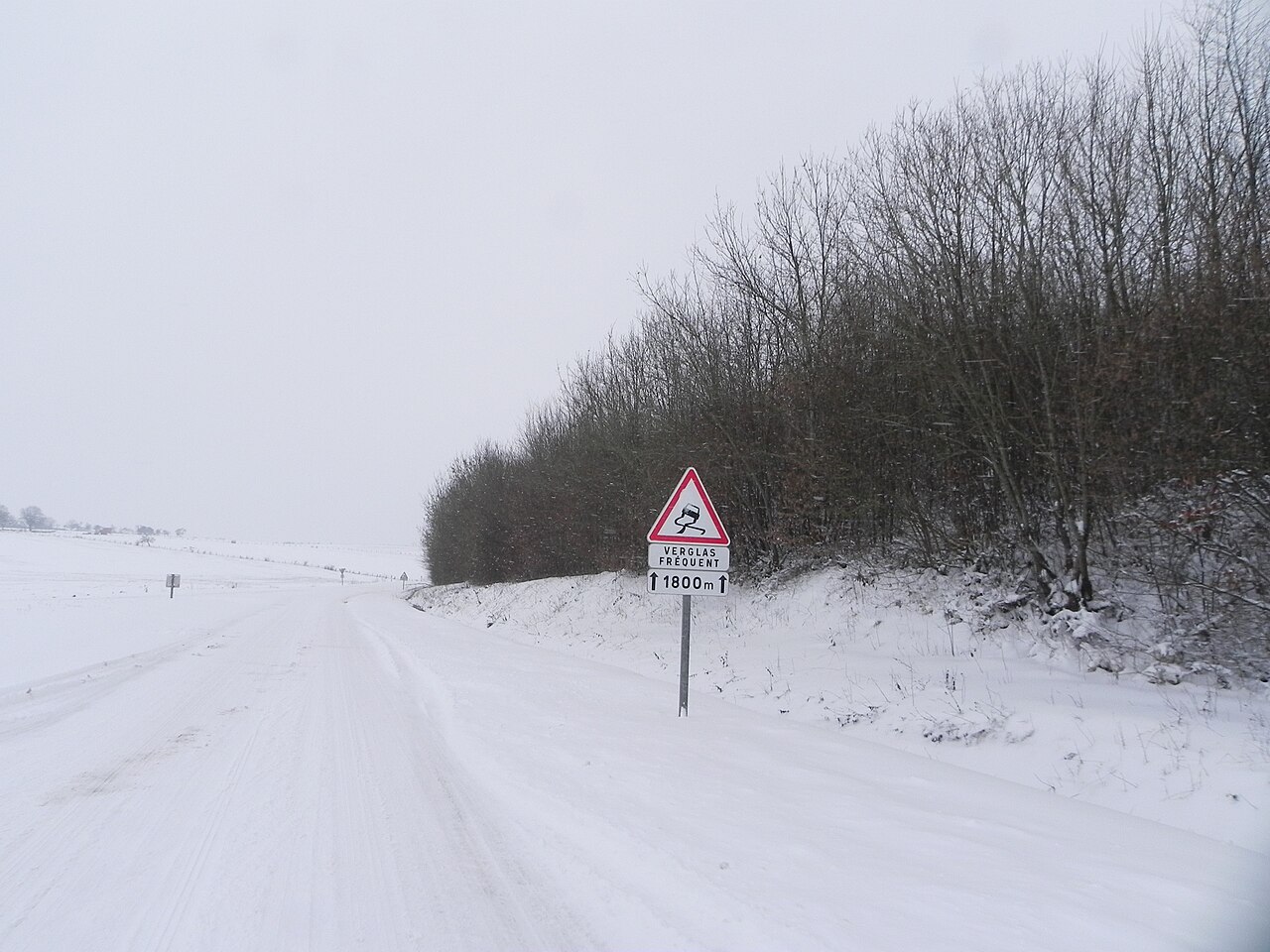
On 1 November, a driving rule applies again in the mountain communes of the Vosges: winter tyres or snow chains become compulsory until 31 March. La Bresse is on the list, along with Gérardmer, Cornimont and Ventron. If your All Saints’ break stretches into November, or you arrive for the first snowy weekends, it is better to settle the question before you set off.
What the rule says
Between 1 November and 31 March, in certain communes of the Vosges massif, vehicles must be fitted with winter tyres or carry snow chains or snow socks. The Vosges prefecture ties the obligation to the Mountain Law II of 28 December 2016 and the decree of 16 October 2020, which cover 48 départements including the Vosges. In its reminder updated on 30 October 2025, it specifies that all vehicles with four wheels or more are concerned: cars, vans, buses and lorries. Signs mark the zones where the equipment is required.
We found no prefecture notice specific to winter 2026-2027: the rule is a standing decree, and the latest news item we read dates from autumn 2025. The official map remains the reference if in doubt.
Which equipment to choose
For a car, van or motorhome, the prefecture gives two options: carry metal or textile chains able to fit at least two driving wheels, or drive with four winter tyres. Coaches, buses and lorries without a trailer have the same choice. A lorry with a trailer must have chains, even if it runs on winter tyres. Vehicles fitted with studded tyres are exempt.
A winter tyre is recognised by two markings: the alpine symbol (three-peak mountain with snowflake) and the letters M+S, M.S or M&S. According to Service-Public, a tyre marked only M+S can still be used, but you must then also carry chains in the vehicle.
The communes around La Bresse
The prefecture’s list, updated in November 2022, includes La Bresse, Cornimont, Ventron, Gérardmer, Xonrupt-Longemer, Le Valtin, Saulxures-sur-Moselotte, Le Thillot, Bussang, Vagney, Le Syndicat, Rochesson, Sapois, Basse-sur-le-Rupt, Fresse-sur-Moselle, Thiéfosse, Tendon, Cleurie, Gerbamont and Remiremont. It covers only the Vosges département: the Alsace side (Markstein, La Schlucht on the Haut-Rhin side) belongs to another département and should be checked separately.
Before you set off
The Sécurité routière leaflet gives three useful pointers. Chains on dry roads: forbidden, because they damage the road surface and can wear out. Speed: 50 km/h maximum with chains. Fitting: practise before leaving and do not wait until the last moment, preferably on level ground.
To follow road conditions, the La Bresse weather page and the Vosges pass webcams give an idea of the day’s conditions. The Route des Crêtes is closed to traffic in winter, and our guide on how to get to La Bresse details the access roads. For the lift opening date, see ski opening 2026-2027.
The 2026 La Bresse guide, ready to download
Access, activities, hikes and useful addresses in one free PDF.
Your details are used only to process this request. Privacy policy (in French).
Free PDF, no newsletter sign-up.
Frequently asked questions
Are winter tyres compulsory in La Bresse?
La Bresse is on the list of Vosges communes where the obligation applies from 1 November to 31 March. You need four winter tyres, or snow chains or snow socks able to fit at least two driving wheels.
Which tyres count as winter tyres?
Those carrying both the alpine symbol (three-peak mountain with snowflake) and the letters M+S, M.S or M&S, according to Service-Public. A tyre marked only M+S can still be used, provided you also carry chains in the car.
Are studded tyres affected?
No, they are exempt. The Vosges prefecture states that the obligation does not apply to vehicles fitted with studded tyres.
Does the rule also apply on the Alsace side, at Markstein or La Schlucht?
The list read here covers only the Vosges département. For the Haut-Rhin, check the Sécurité routière map or the prefecture before you leave.