
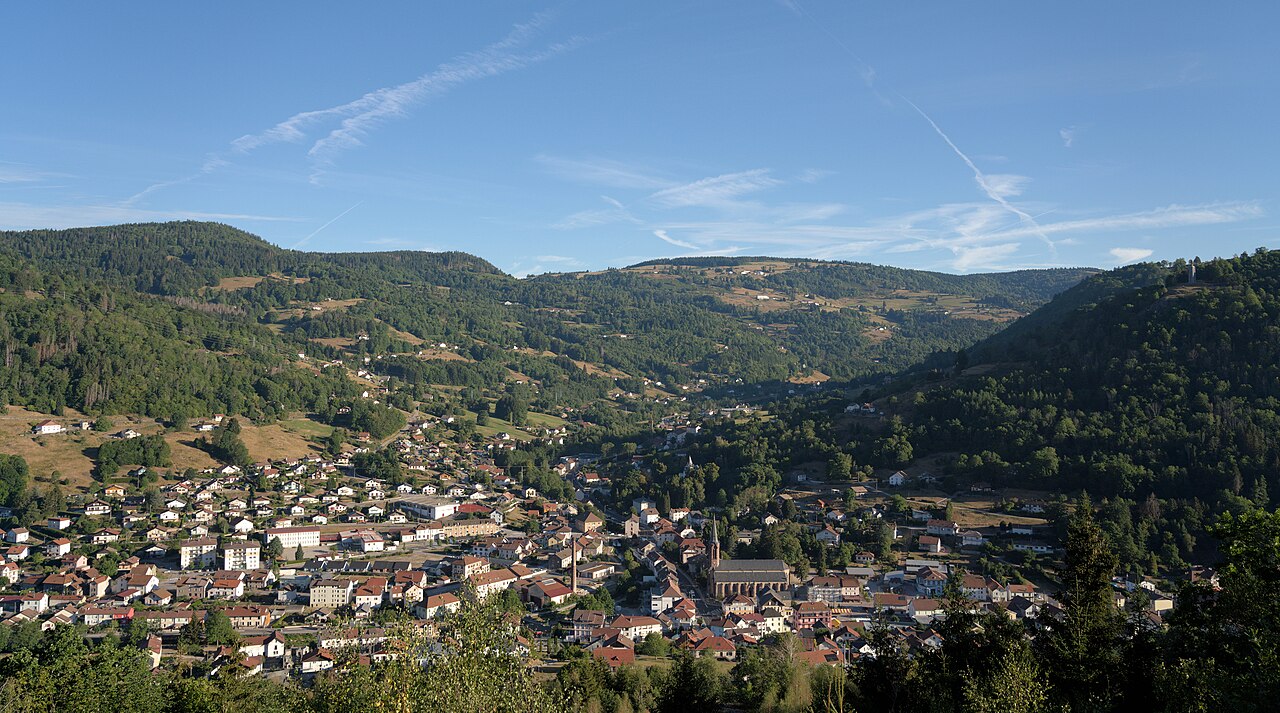
Liézey, Rehaupal and Aumontzey share the Vologne valley, a quarter of an hour’s drive from La Bresse via Gérardmer. These three villages are absent from most guides to the Hautes Vosges, which focus on Gérardmer and La Bresse themselves. Yet they are worth the detour for their rural heritage, their quiet paths and an industrial history tied to the river running through them.
Liézey, the highest scattered village in the valley
Liézey has around 304 residents across 13.27 km², a territory of scattered housing in clearings and hamlets amid the forest. The village was officially created by royal ordinance on 16 May 1836, formed from sections detached from Gérardmer, Granges-sur-Vologne and Champdray. Its residents are nicknamed the “Pouhas”.
The heart of the village, place du Centre, brings together the église Saint-Nicolas, built by residents in 1795, and the village hall, described by the commune as the highest in the Vosges. Liézey belongs to the Communauté de communes de Gérardmer Hautes Vosges and to the Parc naturel régional des Ballons des Vosges. The commune marks out hiking and mountain-biking routes through a landscape of forests and meadows, and lists local producers, craftspeople and a handful of places to stay on its website.
The town hall is open to the public on Monday from 4pm to 6pm, Tuesday from 10am to 11.30am and Thursday from 10am to 12.30pm, with a summer closure planned from 13 to 31 August 2026.
Rehaupal, a quiet stop between Liézey and the Vologne
Rehaupal borders Liézey and shares its membership of the Communauté de communes de Gérardmer Hautes Vosges and the Parc naturel régional des Ballons des Vosges. It is a farming and forestry village, with no developed tourist site or shop in its centre, which makes it a peaceful stop for those returning from a hike on the nearby ridges or a day at the lakes of Gérardmer and Longemer. People here get around mostly on foot or by mountain bike, on paths linking clearings to isolated farms, away from the busier routes of the Moselotte valley.
Aumontzey, the valley’s textile heritage
Aumontzey merged with Granges-sur-Vologne on 1 January 2016 to form the commune of Granges-Aumontzey. The village name appears as early as 1393, in the form “Amonzei”, in administrative archives. Its history is industrial: the entrepreneur Étienne Seitz set up a spinning mill there in 1860, a few years after founding a spinning mill and weaving workshop in Granges in 1856. His successor Didier Walter carried on the operation until the late 19th century.
The chapelle Notre-Dame-du-Saint-Rosaire, with architecture inspired by eastern temples, illustrates this period: it served at once as a place of worship, a performance hall and a water tower for workers’ housing, a multiple use worth a look on the way through.
Granges-sur-Vologne, for its part, brings together several older hamlets (Genazeville, Frambéménil, Berchigranges, among others), collectively known as “Gringeaux”. The five communities united administratively on 26 December 1791 under the name Granges, completed as “Granges-sur-Vologne” by a decree of 1917.
Today, Granges-Aumontzey offers two long-distance regional walking routes, the Boucle Sud and the Tour de la Vologne, as well as group accommodation (Simone Veil) at Champs de la Borde. The reference tourist office for the whole area remains that of Gérardmer Monts et Vallées, place des Déportés in Gérardmer.
Planning a visit from La Bresse
The three villages can be linked in half a day, on foot or by mountain bike, following the small roads that run along the Vologne from Liézey to Rehaupal and then Aumontzey. The area is part of the same state forests where the deer rut can be heard in autumn, from Gérardmer all the way to the edges of La Bresse. To extend the stay, several family campsites in the Hautes Vosges sit less than twenty minutes away, and those after stronger thrills can easily reach the canyoning routes in the Vosges located in the same massif.
A stop at one of the region’s craft breweries rounds off a day of walking between the three villages nicely. In summer, to cool off after the road, the lakes of Gérardmer and Longemer remain the closest and simplest option.
The 2026 La Bresse guide, ready to download
Access, activities, hikes and useful addresses in one free PDF.
Your details are used only to process this request. Privacy policy (in French).
Free PDF, no newsletter sign-up.
Frequently asked questions
How do you get to Liézey from La Bresse?
Allow around a quarter of an hour by car, through Gérardmer and then toward Champdray. No regular public transport service has been identified to these hamlets, so a personal vehicle remains necessary.
What is there to see in Rehaupal?
Rehaupal has no developed tourist site. It is a farming and forestry village, worth wandering through for its calm and its paths linking isolated farms, as a complement to a hike on the nearby heights.
Why do Aumontzey and Granges-sur-Vologne form a single commune?
The two villages merged on 1 January 2016 under the name Granges-Aumontzey. The merger formalises historical ties strengthened in the 19th century by shared textile industry development on both banks of the Vologne.