
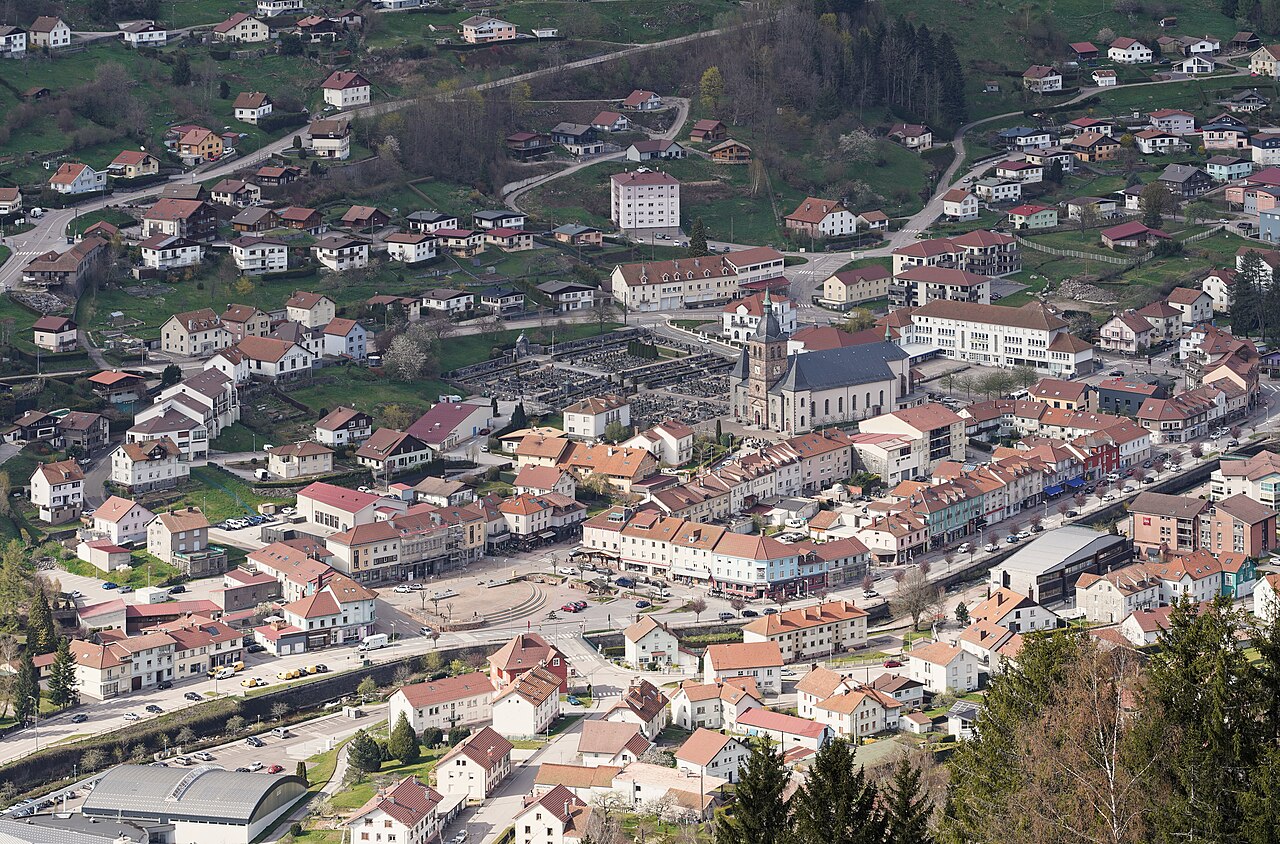
Xonrupt-Longemer brings its lake to mind first, but the commune is far more than a bathing shoreline. Independent from Gérardmer since 1919, it brings together a central village, the hamlet of Le Collet toward the Schlucht, and a lesser-known built heritage. Here is what the village has to tell once you step away from the beaches of Lac de Longemer.
A commune born of the split with Gérardmer
Xonrupt-Longemer became a fully separate commune on 23 October 1919, when a law detached this territory from Gérardmer. The new village started out with around 809 residents, a number that fell to 465 during the war before climbing back to 1,594 according to the municipal archives.
Local place names come from the local patois: “Xonrupt” combines “chon” (wooden plank) and “rupt” (stream), a reference to the wooden bridges that once crossed the Vologne. “Longemer” translates as “the long sea”, since local dialect used “mer” (sea) for these mountain lakes, and “Retournemer” named the lake where travellers had to turn back, unable to cross the mountain further on. A Neolithic site (a polished axe found in 1959 near the lake) points to early settlement, while legend places Charlemagne passing through around the year 800. The first document mentioning Longemer dates from 1285, and it was under Napoleon III, in 1858, that the RN417 road was cut through to open up the valley.
Heritage in the village centre: church, chapel and ski jump
The village built its identity around three landmarks. The Sainte-Bernadette church, in local granite, was built between 1933 and 1934 after a fundraising drive launched by residents; its roof was renovated in 2016.
By the lake stands the Saint-Florent chapel, built around 1449 by the canonesses of Remiremont and rebuilt in 1727. It is said to hold the remains of a hermit named Bilon, who withdrew to a mound by the lake as early as the 11th century. Open to the public during Heritage Days, it remains one of the valley’s few surviving medieval religious buildings.
The village also keeps up a sporting heritage: a ski jump, first envisioned in 1964, has been in use since 1967, with a plasticised, watered take-off track. The local club trained several champions, including Julia Clair (ski jumping), Jean-Paul Pierrat (cross-country skiing), Théo Rochat and Lilian Vaxelaire (Nordic combined). To continue exploring the local heritage, head to La Bresse and its heritage sites and visits.
Le Collet, a mountain hamlet toward the Schlucht
Leaving the village centre on the road to Colmar (D417), the road climbs to Le Collet, a hamlet marking the entrance to the massif toward the Col de la Schlucht and Alsace. It has a hotel-restaurant, designed as a base for exploring the Route des Crêtes in both summer and winter. The hamlet sits a few kilometres from the village centre, on a historically strategic route: it was along this same road that a tramway, designed by engineer Henri Gutton, linked Gérardmer to Xonrupt starting in 1897.
Le Collet reflects the commune’s distinctive geography, stretching between 715 and 1,306 metres in altitude across 3,070 hectares, of which 2,100 hectares are forest, within the boundaries of the Parc naturel régional des Ballons des Vosges.
Local life: schools, camping and community activity
Xonrupt-Longemer remains a village that is lived in year-round, not just a summer destination. The commune has a nursery school and a primary school with supervised study, health services, approved childminders and a children’s day facility. Community life is active, driven by sports clubs, including ski jumping and cross-country skiing, and by a calendar of local events (a lakeside flea market, a woodcutters’ festival, exhibitions).
For outdoor accommodation, a municipal campsite rounds out the village’s offering for summer stays. In winter, a small family-friendly ski area, Le Poli, offers downhill skiing and sledding above the village, with cross-country trails that connect to the Gérardmer and La Bresse ski areas.
Getting there and location for planning your stay
Xonrupt-Longemer lies in the east of the Vosges department, 5 km from Gérardmer, 8 km from La Bresse, 48 km from Colmar and 44 km from Épinal. For train and coach journeys, check the schedules on the commune’s official website before travelling.
Spring and autumn offer the most interesting light for exploring the church, the chapel and the hamlets away from the summer crowds. Summer brings most of the activity around the lake, while winter shifts toward skiing, with preferential rates on Le Poli and the cross-country trails; ask at the town hall for details.
The 2026 La Bresse guide, ready to download
Access, activities, hikes and useful addresses in one free PDF.
Your details are used only to process this request. Privacy policy (in French).
Free PDF, no newsletter sign-up.
Frequently asked questions
Is Xonrupt-Longemer a different commune from Gérardmer?
Yes. Xonrupt-Longemer has been an independent commune since 23 October 1919, when a law separated this territory from Gérardmer. The village started out with around 809 residents, a figure that dropped to 465 during the war before climbing back to 1,594.
What is Le Collet in Xonrupt-Longemer?
Le Collet is a hamlet on the road to Colmar (D417), heading toward the Col de la Schlucht, a few kilometres from the village centre. It has a hotel-restaurant, a convenient starting point for the Route des Crêtes and the Alsatian summits.
What is there to see in the village of Xonrupt-Longemer besides the lake?
The Sainte-Bernadette church, built in local granite between 1933 and 1934, the Saint-Florent chapel by the lake (15th century, rebuilt in 1727), and the ski jump used since 1967, where the local club trained Julia Clair and Jean-Paul Pierrat.