
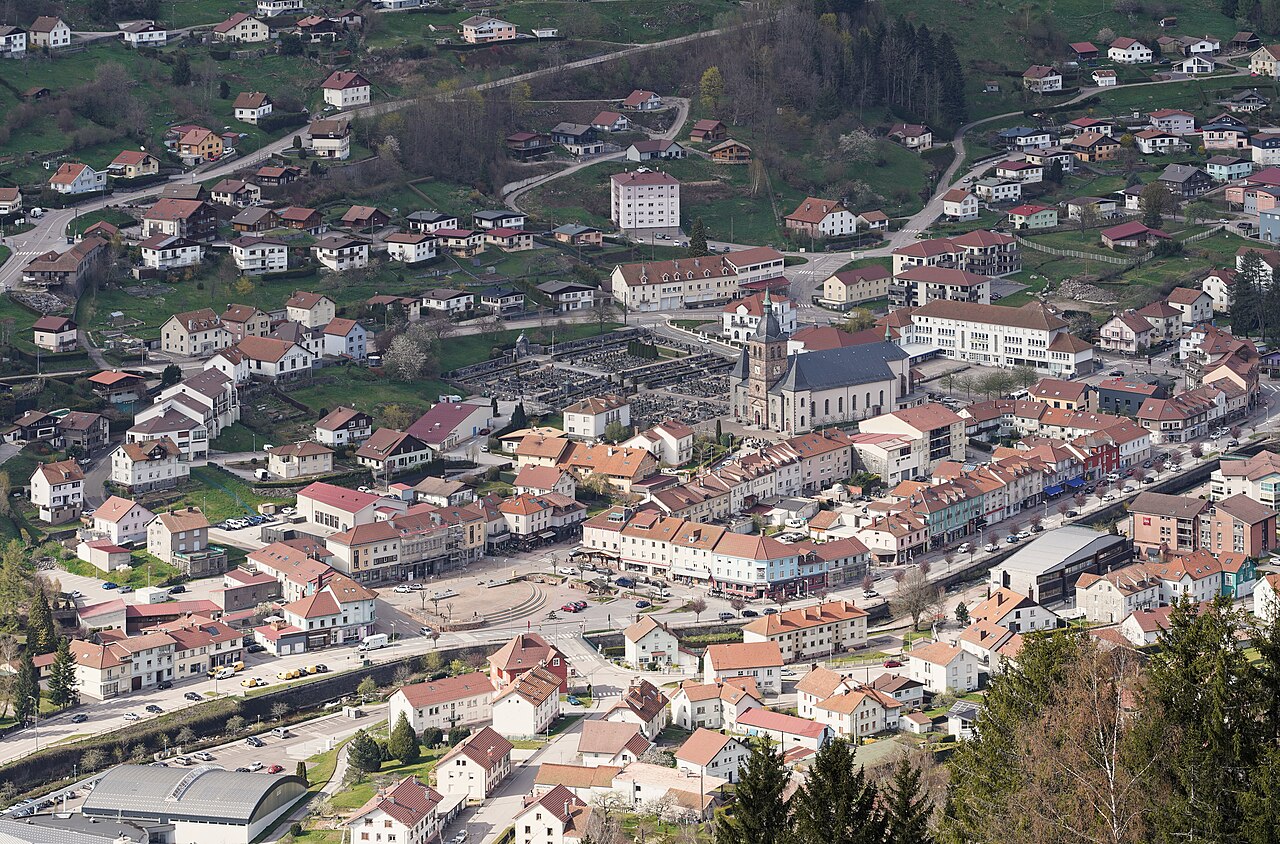
In 1944, La Bresse was 80% destroyed during the Liberation fighting in the Hautes-Vosges: bombing, the forced evacuation of the population, and fires turned the village into a field of ruins. It was then rebuilt entirely between 1945 and 1959, with an urban layout and architecture specific to that period, still widely visible today. Here is what the town hall and the tourist office document about this chapter of La Bresse’s history, and where to see its traces during a stay.
A village rebuilt several times since the Middle Ages
The history of La Bresse goes back to the 7th century, when monks travelling between Munster and Remiremont settled in this area, then used as a hunting reserve by Frankish lords. The Bresse community then built its own administration and its own justice system, an autonomy that lasted until the French Revolution and the abolition of feudal privileges.
The village grew mainly after 1830, thanks to the exploitation of a 3,000 hectare communal forest, granite quarries, and a textile industry set up along the waterfalls. From 1905, hydroelectric production from lake water gave a further boost to this local economy. Tourism, particularly winter sports, only developed from the 1960s onward, after the period covered here.
According to the La Bresse town hall, the 1944 destruction was the fourth nearly total destruction of the village in five centuries. This history, marked by successive destructions and reconstructions, partly explains why so few architectural elements predating the Second World War remain in the village centre.
Autumn 1944: the village wiped off the map
La Bresse lies on the front line of the fighting between German troops and Allied forces, backed by the Vosges maquis, during the Liberation of the Hautes-Vosges. The town hall sums up what the town endured: 80% of the town destroyed, 4,000 people evacuated then displaced out of a population of 5,000, and 800 buildings destroyed.
This period is also marked by the fighting commemorated today on the hills above the village, at the Maquis de la Brayotte, and at the Monument des Combes, where 27 resistance fighters killed during the clashes of September 1944 are commemorated, according to the tourist office. These memorial sites, separate from the village itself, tell the military side of this same historical episode, when the Brayotte massif and the area around La Bresse were at the centre of the Vosges Resistance fighting.
1945 to 1959: reconstruction and modern town planning
The village’s reconstruction ran from 1945 to 1959. Town planner Émile Deschler designed the plan for the new town centre as well as several buildings, while many other architects worked on rebuilding the farms and individual houses in the outlying hamlets.
The architecture of this period, as described by the town hall, can be recognised by several features: corner buildings and continuous street frontages, matching bands, lintels and roofs, symmetry and clean lines, granite bases paired with cement window surrounds, and elaborate entrances with projecting concrete canopies. These buildings also brought new comforts for the time: large windows, smaller rooms, running water.
This Reconstruction-era architecture, sometimes judged by the town hall itself to lack strong individual character, remains a testament to the village’s modernity and resilience in the 20th century. It now makes up most of the built fabric visible in the centre of La Bresse.
Seeing this history today
Walking through the village centre, the continuous street frontages, the granite bases, and the canopied entrances tell this post-war reconstruction story directly, without needing to step into a museum. To extend a stay with other sites linked to this period and to earlier centuries, the guide to heritage and history around La Bresse covers the Saint-Laurent church, the Resistance memorial sites, and nearby places such as the Musée du Textile in Ventron or the Hautes-Mynes du Thillot.
For those staying several days, this piece of history combines easily with the village’s outdoor activities: an afternoon of tree-top adventure trails in the Vosges forest pairs well with a morning devoted to the memorial sites, without overloading the schedule.
Planning your trip
To plan a stay centred on this heritage, the access guides detail the routes depending on where you set off from: from Paris, from Belgium, or from Germany. For more detail on the facts, figures, and precise dates, the La Bresse town hall points to the archives of the “La Bresse Infos” municipal bulletins, which hold more detailed documentation on this period.
The 2026 La Bresse guide, ready to download
Access, activities, hikes and useful addresses in one free PDF.
Your details are used only to process this request. Privacy policy (in French).
Free PDF, no newsletter sign-up.
Frequently asked questions
Why was La Bresse destroyed in 1944?
The village lies on the front line of the Liberation fighting in the Vosges massif in the autumn of 1944. According to the La Bresse town hall, the town was 80% destroyed, with 800 buildings lost and 4,000 residents evacuated or displaced out of a population of 5,000.
How many buildings were destroyed in La Bresse in 1944?
The La Bresse town hall records 800 buildings destroyed across the town. According to the same source, this was the fourth nearly total destruction of the village in five centuries.
How was the current town centre of La Bresse rebuilt?
The reconstruction ran from 1945 to 1959. Town planner Émile Deschler drew up the plan for the new town centre and several buildings, in a distinctive style: continuous street frontages, matching bands and lintels, granite bases, and large windows bringing greater comfort and light.