
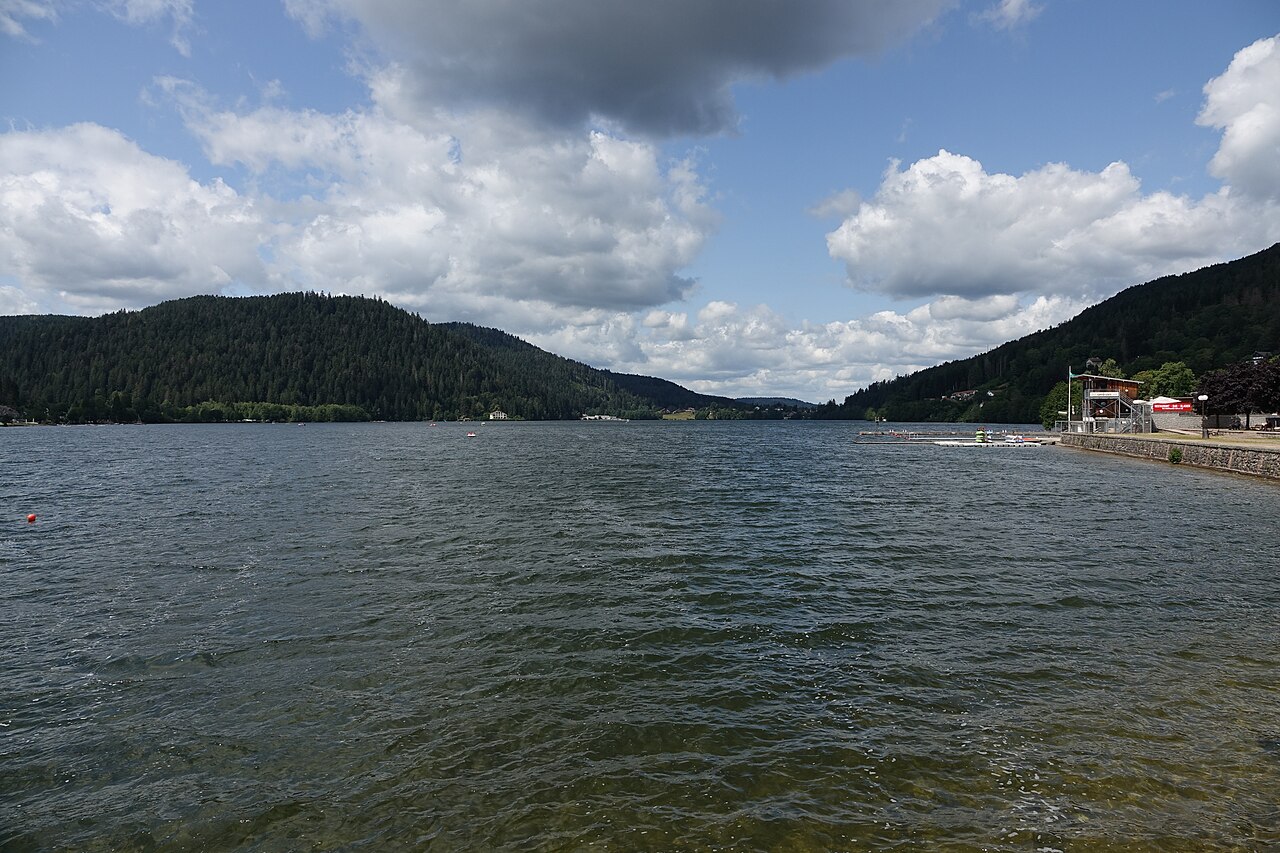
Lac de Pierre-Percée covers 304 hectares and reaches up to 80 metres deep. Created by the EDF dam at Vieux-Pré, it is one of Lorraine’s largest artificial reservoirs. It sits among forest and pink sandstone cliffs in the Meurthe-et-Moselle department, at the heart of the Pays des Lacs.
North of La Bresse, it offers a full-day excursion into a completely different landscape while staying within the Vosges tourism area.
Update of 6 October 2026: the 2026 season is over and swimming remains banned on both lakes. It is banned in Lac de Pierre-Percée and has no longer been offered or allowed at Lac de la Plaine since 2024, according to the site operator (Pays des Lacs), which gives no reopening date. In 2026, kayaking, pedal boats and towable tubes were offered on the smaller lake. No information on the 2027 season is published on the pages consulted: 2027 status to be confirmed with the leisure base.
A lake on another scale
With 3.04 km² of surface area, nearly 35 kilometres of waymarked hiking and mountain-bike trails and 61 million m³ of water, Pierre-Percée dwarfs the other Vosges lakes. Its distinctive oak-leaf shape creates multiple coves and inlets edged with fir trees and sandstone cliffs. In dry summers the water level can drop sharply, revealing an almost lunar landscape of exposed ochre earth and emerging rocks.
The lake sits at 386 metres altitude at its maximum level in the commune of Pierre-Percée (Meurthe-et-Moselle), on the border of the Vosges department.
Activities
Swimming: banned on both lakes. Lac de la Plaine no longer offers or allows it since 2024, and the operator’s page presents it as closed, with no reopening date. Do not plan on swimming there; for 2027 the status remains to be confirmed with the leisure base (+33 3 29 41 13 04).
Water sports: in 2026, the leisure base at Lac de la Plaine offered kayaking, pedal boats and towable tubes. These activities were not affected by the swimming closure. The 2027 opening calendar is not published on the pages consulted: check with the base before travelling.
Hiking: the waymarked network around the lake totals nearly 35 kilometres of hiking and mountain-bike trails through forest. Key stops include the Roche des Corbeaux (panoramic viewpoint over the lake and Plaine valley), the Roches de la Xaveure and the ruins of Château de Salm.
Fishing: see the dedicated section below.
Fishing at Lac de Pierre-Percée
The lake holds the national “parcours passion” label from the Fédération Nationale de la Pêche en France (FNPF). It is one of the most highly rated fishing destinations in Lorraine.
Species present:
- Whitefish (corégone / féra), introduced in 1989, the lake’s signature species
- Trout
- Pike
- Zander (sandre)
Regulations given by the fishing federation:
- The lake is open to line fishing year-round, with species-specific seasons: check the current order issued by the Meurthe-et-Moselle fishing federation
- Daily bag limit: 6 salmonids per angler
- Predators (pike or zander): 1 fish in total per angler per day
- Minimum catch size: trout 25 cm, whitefish 30 cm, pike 60 cm, zander 50 cm
Fishing licence: mandatory. An AAPPMA licence from Meurthe-et-Moselle or an inter-federation licence is required to fish with more than one line. Check the official 2026 guide and regulations before setting up.
Launch ramps: four equipped ramps with parking: Anse des Bordes, Pierre-Percée, Basse Nangoutte and Pré-Barbier. Access can vary with the water level, so check the current ramp status before travelling. Life jackets are compulsory.
Practical information
Getting there from La Bresse: north to Celles-sur-Plaine, then Pierre-Percée. Check the route and driving time in your navigation tool.
When to go: the water sports base and hiking are mainly spring and summer activities; the base’s 2027 calendar is not published. According to the federation, line fishing is allowed from 1 January to 31 December on this lake, with species-specific periods. Avoid July-August weekends if you prefer quieter conditions. The Vosges prefecture published an item on 30 September 2026 about the extension of a drought situation: check the prefecture’s website for the restrictions in force. Fires and wild camping are banned on the site according to the operator.
On-site accommodation: Camping des Lacs at Celles-sur-Plaine.
Leisure base contact: La Grande Haie, 88110 Celles-sur-Plaine. Tel. +33 3 29 41 13 04.
Why make this trip from La Bresse
La Bresse offers mountain lakes and Vosges highlands. Pierre-Percée delivers something completely different: a vast lowland lake, a remote-feeling forest landscape of pink sandstone, and labelled fishing for whitefish on one of Lorraine’s finest spots. A full day that broadens the whole trip.
See also
The La Bresse guide, summer edition
Trails, lakes, blueberries and farm inns, in one free PDF.
Your details are used only to process this request. Privacy policy (in French).
Free PDF, no newsletter sign-up.
Frequently asked questions
Is swimming allowed in Lac de Pierre-Percée?
No. Swimming is banned in Lac de Pierre-Percée and has no longer been allowed at Lac de la Plaine since 2024, according to the operator, which gives no reopening date. The 2027 status remains to be confirmed with the leisure base.
What water activities did the leisure base offer in 2026?
The Lac de la Plaine leisure base offered kayaking, pedal boats and towable tubes while swimming was closed. The 2027 opening calendar is not published on the pages consulted as of 6 October 2026.
Will the leisure base run a 2027 season?
Not announced yet. As of 6 October 2026, neither Pays des Lacs nor the leisure base publishes dates or rules for 2027 on the pages consulted.
Can you fish at Lac de Pierre-Percée?
Yes. The lake holds the "parcours passion" label from the Fédération Nationale de la Pêche en France. It holds trout, whitefish, pike and zander. A valid fishing licence is compulsory (AAPPMA of Meurthe-et-Moselle, or an inter-federation licence to fish with several lines). Four launch ramps are available.
How far is Lac de Pierre-Percée from La Bresse?
Lac de Pierre-Percée lies north of La Bresse, in Meurthe-et-Moselle, on the edge of the Vosges department. None of the sources read gives a driving time from La Bresse.
How deep is Lac de Pierre-Percée?
The lake reaches up to 80 metres deep. Its 304 hectares and deep coves make it a mountain lake suited in particular to whitefish.
Is access to the lake paid?
Access to the leisure base is free, as are the lake circuit and the hiking trails. The base's water activities were paid in 2026. Fishing requires a valid licence.
What hikes can you do around the lake?
The waymarked network around the lake totals nearly 35 km of hiking and mountain-bike trails. Highlights are the Roche des Corbeaux, the Roches de la Xaveure and the ruins of Château de Salm.