
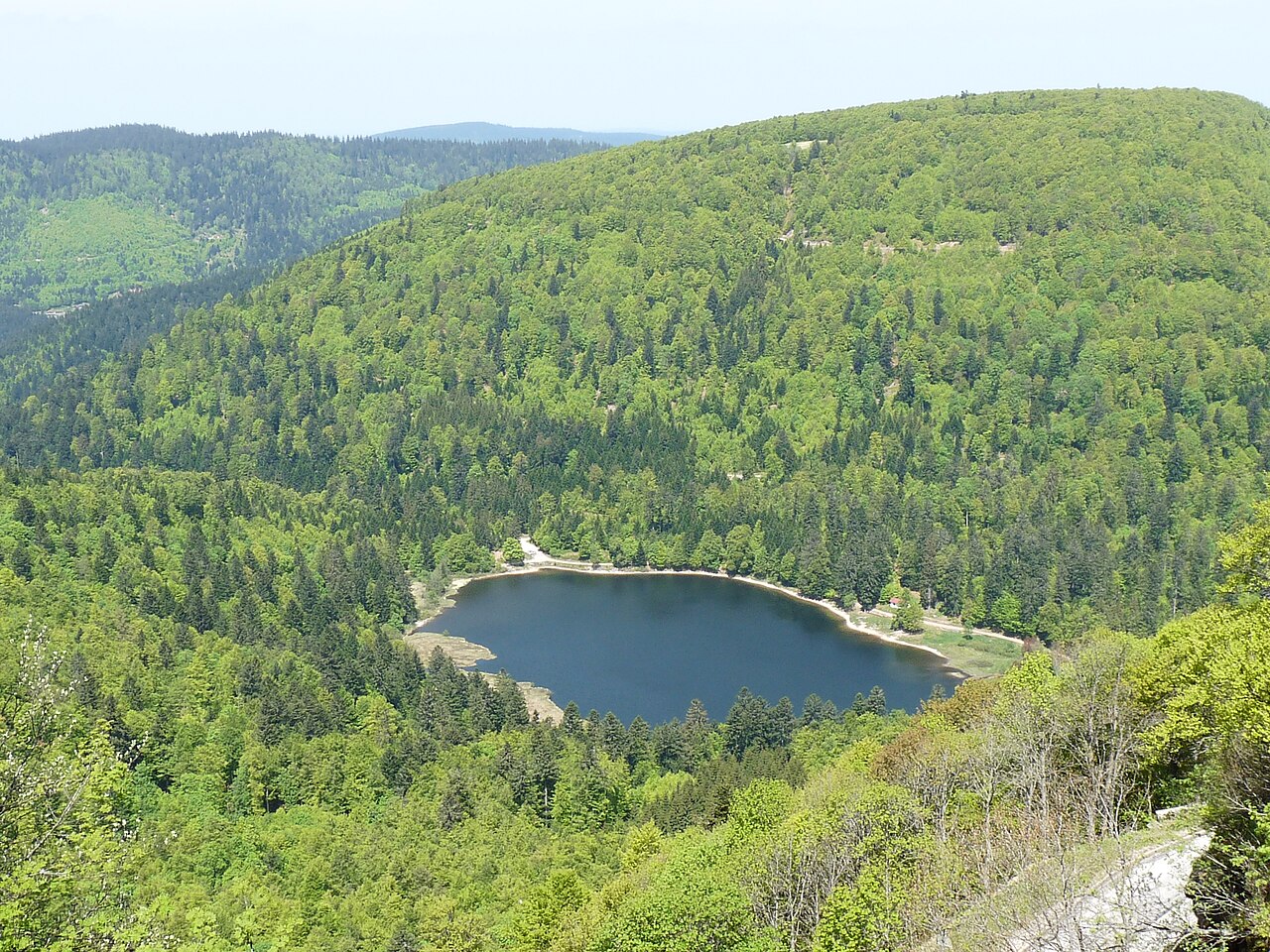
At 984 metres altitude, around 9 hectares and 15 m deep, Lac de Blanchemer has a very different face from its big brother Lac des Corbeaux: more discreet, fringed with peat bogs, surrounded by dense fir forest, it embodies the wild Vosges.
Geological formation: a glacial cirque lake
Blanchemer is a glacial cirque lake formed around 15,000 years ago, at the end of the last Würm glaciation. A mountain glacier carved the relief, leaving behind an impermeable basin fed by precipitation and underground springs. The catchment area covers approximately 2.5 km², draining the forested slopes of the Bramont massif. The water is fresh, slightly acidic and low in minerals: this is what encourages the development of the peat bog on its fringes.
A unique ecosystem
Blanchemer sits inside a peat bog classified as a protected natural area. Remarkable species found here include:
Specific flora:
- Round-leaved sundew (Drosera rotundifolia): a carnivorous plant that traps insects with its sticky leaves. Visible from May to August on the wet sphagnum zones.
- Common cottongrass (Eriophorum angustifolium): its white cotton pompoms float in the wind from May to July, a striking visual marker of the peat bog.
- Sphagnum mosses: the mosses that form the peat carpet, absorbing water like a sponge.
- Local orchids: the spotted orchid (Dactylorhiza maculata) and the fragrant orchid are visible in June and July in the transition zones between forest and bog.
Best time to observe the flora: May for early orchids, June for cottongrass in full flower, July for fully open sundews.
Wildlife:
- Dragonflies: several species including the rare whiteface (Leucorrhinia dubia), rare in France and confined to acidic peat bogs. Present from June to August.
- Amphibians: common frogs, Alpine newts in the shallows, tadpoles visible in May and June.
- Goosander: this diving duck is sometimes spotted on the lake, especially at the end of the day and early in the morning.
- Raptors: birds of prey regularly soar over the lake in the late afternoon, including buzzards and kestrels.
Wooden walkways cross the zone without damaging it.
Photography at Blanchemer
The lake is an exceptional photographic subject, provided you choose the right moment.
Best light: in the morning between 7am and 9:30am. The water surface is often perfectly calm at this hour, offering mirror reflections of the fir tree line and the sky. In the afternoon, wind generally picks up and breaks the reflections.
Reflections and seasons:
- Autumn (October-November): golden larches and russet beeches create extraordinary warm reflections.
- Spring (May): fresh vegetation, cottongrass pompoms in the foreground.
- Winter with snow: frozen banks and snow-covered firs give a Nordic atmosphere.
- Summer: the raking light of late afternoon can compensate for the absence of morning mist.
Recommended positions:
- From the walkway on the peat bog side (south-west) for the first light
- From the north-bank path to include the ridge line in the background
- At the water’s edge on the east side for reflections of the dense forest
Equipment: tripod essential for low morning light, polarising filter recommended to cut surface reflections when you want to see the lakebed.
The lake loop
- Distance: 1.5 km
- Elevation: minimal
- Duration: 40 min
- Level: easy
The path circles the lake through the woods, with regular openings onto the water. Educational panels on the fauna and flora.
Blanchemer with children
The lake loop is one of the rare Vosges hikes accessible to children from age 4 to 5 with no particular difficulty.
Discovery trail: the path is equipped with educational panels explaining glacial formation, carnivorous plants and the workings of peat bogs. A good starting point for awakening young naturalists’ curiosity.
Distance from car park: about 10 minutes’ walk on a flat, well-maintained track. The full loop (1.5 km) can be done comfortably in 45 to 60 minutes with curious children stopping at the panels.
Practical tips:
- A naturalist’s magnifying glass is great for observing sundews and insects up close.
- Binoculars for spotting dragonflies and birds.
- Do not leave the path: the peat bog is fragile and can be treacherous (soft ground).
- Wear closed waterproof shoes even in summer.
Comparative table: Blanchemer, Lac des Corbeaux, Lac de Longemer
| Criterion | Blanchemer | Lac des Corbeaux | Lac de Longemer |
|---|---|---|---|
| Altitude | 984 m | 723 m | 738 m |
| Surface | 9 ha | 12 ha | 76 ha |
| Swimming | Forbidden | Permitted | Permitted |
| Peat bog | Yes, protected | Partial | No |
| Atmosphere | Wild, quiet | Wild, less visited | Touristy, lively |
| Car access | Nearby car park | Nearby car park | Direct from D417 |
| Ideal for | Photography, nature study | Family, quiet swimming | Beach, water sports |
Extend the walk
For a full day, push on towards the Col de Bramont, the Rainkopf or the Tête des Perches. Superb views over the Vosges and Alsace valleys.
Nearby activities all year
Summer:
- Picnic by the lake (grassy area near the car park)
- Continue towards the Col de Bramont and the Rainkopf (2 extra hours)
- Farm inn nearby for a munster-and-potato lunch
Winter:
- Snowshoeing: the lake loop on snowshoes is an ideal winter outing, 2 hours with children
- Ski touring towards the Rainkopf (1,305 m) from the Col de Bramont: 300 m of climbing, panoramic views over the Franco-Alsatian ridges
Access
From La Bresse, take the Cornimont road then the D34 towards Col de Bramont. Signed car park, about 20 minutes by car from the village centre.
Tips
- Avoid July-August weekends, very busy
- Best light in the morning for reflections
- Farm-inn a few kilometres away, ideal for a munster-and-potato lunch
A perfect stop for anyone after preserved nature, 20 minutes from the village.
Where to stay
Chalets in La Bresse: quiet spots, 15 to 25 min drive from Blanchemer. Ideal base to link the lake, Hohneck and Route des Crêtes.
Nearby reads
- Hohneck hiking: 5 tested routes
- Lac des Corbeaux: the must-do loop
- Route des Crêtes: the panoramic drive
The La Bresse guide, summer edition
Trails, lakes, blueberries and farm inns, in one free PDF.
Your details are used only to process this request. Privacy policy (in French).
Free PDF, no newsletter sign-up.
Frequently asked questions
Can you drive to Lac de Blanchemer?
Yes, up to a car park about 10 minutes' walk from the lake. Space is limited in high season, so arrive early.
Is swimming allowed?
No. Swimming is forbidden at Blanchemer to protect the peat-bog ecosystem. Looking and photographing only.
What's so special about the site?
The protected peat bog hosts sundews, cottongrass, sphagnum mosses and several rare orchids. Wooden walkways cross the zone without damaging it.
Is the loop suitable for children?
Yes. 1.5 km, barely any elevation, educational panels all along. Good trainers are enough in dry weather.
When is the best time to visit?
Weekday mornings in June and September: gorgeous light, no crowds. Avoid July-August weekends.