
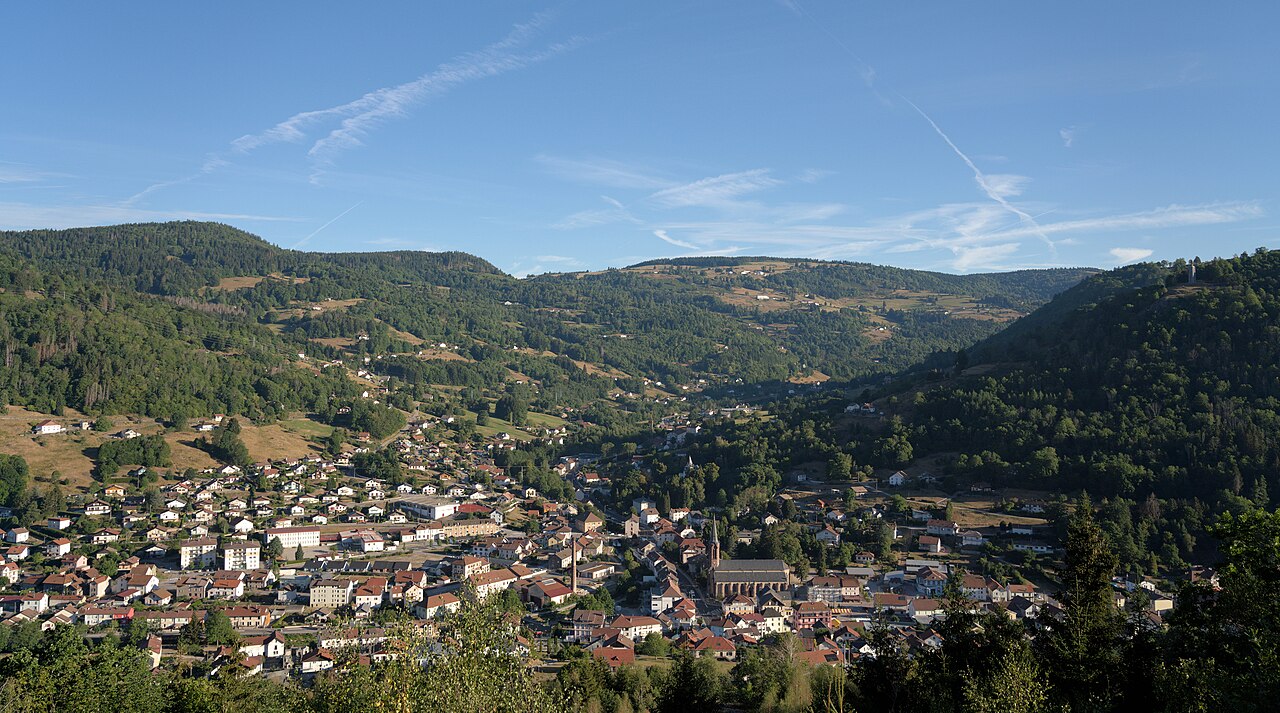
Beyond the Musée du Textile de Ventron, the valleys of the Hautes-Vosges still hold tangible traces of their industrial past: mills along the riverbanks, marked trails, and manufacturer shops still in business. This overview brings together the accessible sites that show how textiles shaped these villages, along with the practical details needed to plan a day out.
The Route du Textile Vosgienne: four itineraries for reading the landscape
Run by the association Vosges Terre Textile, the Route du Textile lists around forty points of interest spread across four driving itineraries, each with its own distances and duration. The Moselotte itinerary connects Vagney to La Bresse and covers several production sites, shops and discovery sites, including the Sentier du Textile in La Bresse (full route on routedutextile.fr). Three other itineraries (Gérômois, between Gérardmer and Saint-Dié; Moselle, between Rupt-sur-Moselle and Saint-Maurice; and la Plaine, between Remiremont and Nomexy) complete the network across the whole range.
Every stop is marked with a panel and a code you can scan for 360 degree virtual tours, photo galleries and clips from institutional films, all available on routedutextile.fr. It’s a way to plan a driving circuit, or to revisit a site remotely after seeing it in person, for instance after the Musée du Textile de Ventron.
The Sentier du Textile in La Bresse: walking between mills and canals
In La Bresse, the Sentier du Textile offers three marked walking routes, set up by the local company Tissus Gisèle. The full circuit runs 11 km over about 4.5 hours, starting from the Les Écorces site. Two shorter loops make for a lighter outing: the Chajoux loop (3 km, about 1.5 hours), starting from the Les Zelles site in the Chajoux valley, and the Vologne loop (4 km, about 2.5 hours), also from Les Écorces.
The route relies on illustrated theme panels and landscape viewpoints that show concrete elements of the textile trade: mills, workers’ housing, water supply canals and sluice gates that once powered the machines. A booklet available on site offers a family trail game with questions about the route’s features. The main starting point is at ZI Les Écorces, 8 chemin des Écorces in La Bresse. The trail is exposed to weather conditions, so it’s worth checking the state of the paths beforehand, especially after rain.
This reading of the landscape complements our guide to the heritage and history around La Bresse, which also covers the memorial sites and the Ventron museum.
Vagney and Bleuforêt: textile manufacturing still in business
Unlike most spinning mills that have been converted into museums, the Bleuforêt mill in Vagney still manufactures socks and tights “Made in Vosges” today, continuing the hosiery workshops that built the valley’s reputation. The factory shop, open several days a week, stocks the full range of men’s and women’s collections made on site: it’s best to check the exact hours before going, as they change from season to season.
Tours of the manufacturing workshop are not open to individual visitors on an ongoing basis. They are offered during a dedicated factory-visit week, held every two years since 2012 by Vosges Terre Textile, with registration required, limited capacity, and access not recommended for visitors with reduced mobility due to steps along the route. For upcoming dates, the site vosgesterretextile.fr remains the reference to check before planning a trip.
Planning a textile heritage outing from La Bresse
These sites combine easily over a single day or a longer stay. The Sentier du Textile suits a morning walk, the Bleuforêt shop works as a stop at the end of the day on the way to Vagney, and the Musée du Textile de Ventron makes for an indoor visit on rainy days. For a multi day stay in the area, the family campsites of the Hautes-Vosges offer a practical base near the valleys covered by the Route du Textile.
In late September, when this guide was published, a hike along the textile trail pairs well with a swim in the late afternoon at one of the Vosges lakes still open for swimming, or with a dusk outing to try to hear the stags rutting in the Gérardmer forest, close to the industrial valleys described here.
Opening hours, days and event dates change from year to year: check them on the official sites (labresse.net, routedutextile.fr, vosgesterretextile.fr) before you go.
The 2026 La Bresse guide, ready to download
Access, activities, hikes and useful addresses in one free PDF.
Your details are used only to process this request. Privacy policy (in French).
Free PDF, no newsletter sign-up.
Frequently asked questions
How much time should I plan for the Sentier du Textile in La Bresse?
There are three routes: the Chajoux loop (3 km, about 1.5 hours), the Vologne loop (4 km, about 2.5 hours) and the full trail (11 km, about 4.5 hours). Starting points are at the Tissus Gisèle sites, in Les Écorces or Les Zelles.
Can you tour the Bleuforêt mill in Vagney?
The factory shop is open several days a week, but exact hours change: it's best to check on site or with the tourist office before going. Tours of the manufacturing workshop are not offered on an ongoing basis: they take place during a dedicated factory-visit week, held every two years since 2012 by Vosges Terre Textile, and registration is required.
Which Route du Textile itinerary is closest to La Bresse?
The Moselotte itinerary connects Vagney to La Bresse and covers several production sites, shops and discovery sites, including the Sentier du Textile in La Bresse. The detailed route is available on routedutextile.fr.