
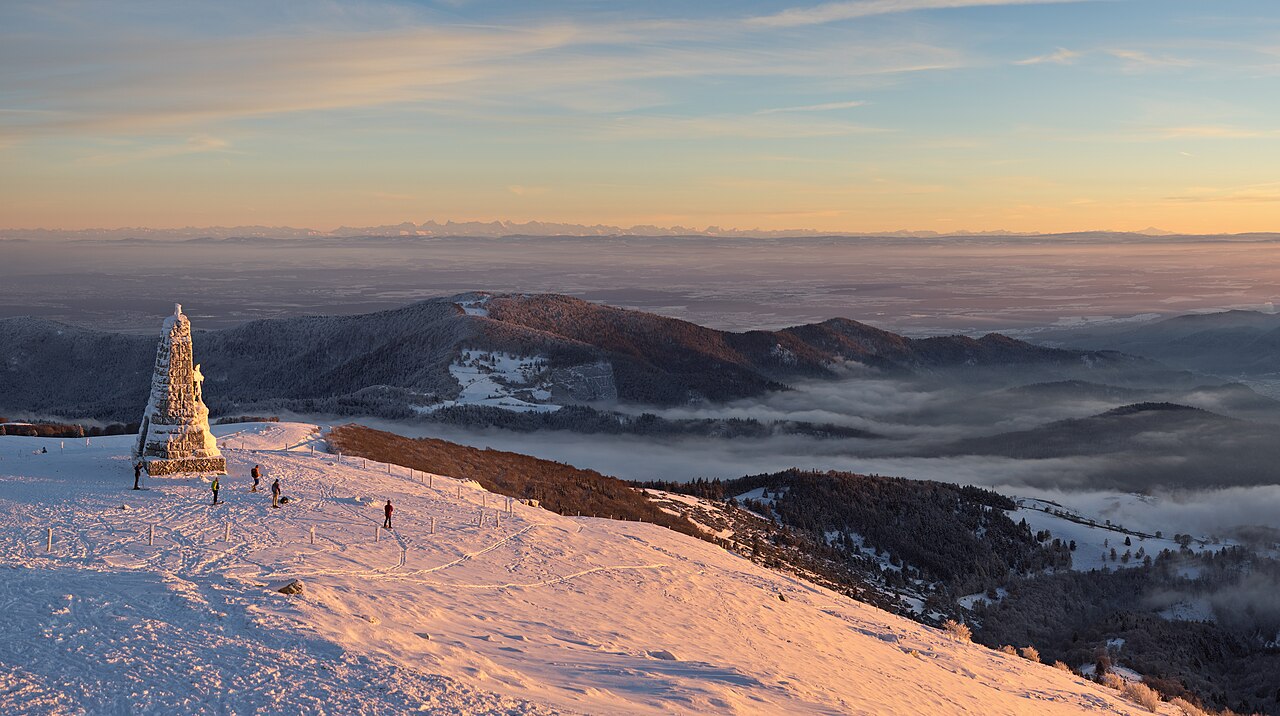
Created in 1989, the Ballons des Vosges Regional Nature Park covers 2,800 km² across the Vosges, Alsace, Franche Comté and Lorraine. La Bresse and all the villages mentioned on this site lie within the park.
Park governance
The Ballons des Vosges Park is an original structure bringing together 4 departments (Haut-Rhin, Bas-Rhin, Moselle, Vosges) and 194 communes around a shared project. Its governance rests on a mixed syndicate grouping the relevant local authorities, which defines and funds the park’s actions.
The RNP charter, the founding document, is renewed approximately every 15 years. It sets the objectives for protection, development and sustainable management for the period concerned. Communes vote freely on their membership and must meet specific commitments on urban planning, agriculture and the preservation of natural environments to keep the label.
The RNP’s missions
- Protection of remarkable natural environments (peat bogs, high pastures, old forests)
- Showcasing of cultural and architectural heritage
- Economic development with respect (short supply chains, sustainable tourism)
- Awareness raising among inhabitants and visitors
Protected habitats
High pastures (chaumes)
The chaumes are those open altitude grasslands that crown the Vosges summits. They are not naturally open: it is herds of Vosges cattle that have kept the vegetation low for centuries. Without grazing, the beech forest would reclaim them in under 20 years. The RNP encourages late mowing (after 15 July) on hay meadows, allowing plant species to flower and seed. These practices keep yellow gentian, Turk’s cap lily, narcissus and dozens of other species alive on the slopes.
Peat bogs
The Vosges peat bogs are among the most fragile and valuable environments in the massif. They form over thousands of years through the accumulation of sphagnum moss in impermeable depressions. A single footprint in a raised bog can create a breach that takes 50 years to heal: this is why boardwalks are systematically installed across peat zones. The RNP prohibits drainage, ploughing and dumping in catalogued peat bogs.
Forests
Vosges forests cover around 65% of the RNP territory. The park charter sets rules on forestry operations: no clear-cutting over large areas, retention of standing dead wood (essential for saproxylic insects and woodpeckers), preservation of the oldest trees. Conifer monocultures, introduced massively in the 19th century, are progressively replaced by mixed species better adapted to climate change.
The natural treasures
- Altitude pastures: unique summit grasslands, refuge for specific flora
- Peat bogs: rare environments, climate sponges, exceptional biodiversity
- Beech and fir forests, primary or little exploited
- Glacial lakes (Blanchemer, Corbeaux, Longemer, Retournemer)
- Wildlife: chamois, lynx (discreet), capercaillie, peregrine falcon
Emblematic species of the RNP
Capercaillie (Tetrao urogallus)
The capercaillie is the park’s symbol. This large forest bird is one of the most threatened species in western Europe. Only a very small number remain in the Vosges, in protected forest zones. Their sensitivity to winter disturbance is extreme: a walker who flushes one in winter can fatally exhaust it. Strict quiet zones are marked on the northern slopes of the massif.
Peregrine falcon (Falco peregrinus)
Back from the brink after almost disappearing due to pesticides in the 1970s, the peregrine falcon nests once more on the Vosges cliff faces. It can be spotted from the ridges, often hunting in the late afternoon.
Eurasian lynx (Lynx lynx)
The lynx is present discreetly in the Vosges, mainly in the Donon massif and the Lorraine slopes. Its presence is confirmed by camera-trap monitoring and predation marks on deer. Direct sightings are extremely rare. It poses no danger to hikers.
Chamois (Rupicapra rupicapra)
Successfully reintroduced since the 1960s, the Vosges chamois is well established. They are regularly seen on the slopes of the Hohneck, Ventron and the ridges between the Grand Ballon and the Ballon d’Alsace. Early morning on exposed slopes is the best time to spot them.
Spotted salamander (Salamandra salamandra)
The icon of the humid Vosges forests, the black and yellow salamander is found in all forest streams. It comes out mainly at night or in autumn rain. Its skin venom is effective against predators but harmless to humans.
Thematic trails in the RNP
The park has developed several labelled itineraries to discover natural environments with educational explanations:
- Peat bog trail at La Basse-sur-le-Rupt: accessible from La Bresse, 3 km, wooden boardwalks through an active peat bog. Interpretation panels on peat formation, carnivorous plants and associated fauna.
- Vosges chalets trail: discovery itinerary of traditional marcaire architecture, with their characteristic overhanging roofs. Available from several Hautes Vosges villages.
- Ornithology thematic trails: several waymarked loops for forest bird observation, with hides at strategic points.
The RNP visitor centre
The park visitor centre is located in Munster, on the Alsatian side (about 40 km from La Bresse via the ridges). It welcomes visitors with permanent exhibitions on the natural environments, fauna, flora and cultural heritage of the massif. Brochures, maps and hiking advice are available free of charge.
Eco-tourism and labels
The Ballons des Vosges RNP groups several responsible tourism labels:
- Accueil Vélo: certified accommodation and services for cycle tourists (secure bike storage, repair tools, gear drying)
- Stations Vertes: La Bresse holds the Station Verte label, a commitment to environmental quality and diversity of nature activities
- Gîtes Panda: accommodation labelled by WWF France, offering wildlife observation activities and local biodiversity awareness
What to respect
- Dogs on leash compulsory in protected zones
- Picking limited to family use with authorised tools (hand comb for blueberries)
- No fires outside fitted fireplaces
- Bivouac only, no wild camping
- Stay on paths in sensitive zones
Contributing as a tourist
Visiting the park is also an opportunity to participate in the knowledge and preservation of biodiversity:
- Citizen science: the iNaturalist app or the Faune-Alsace and Faune-Lorraine sites let you submit species observations. Data feeds the scientific databases used for park management.
- Volunteer associations: the Groupe Ornithologique et Naturaliste (GON) in Alsace and the LPO Lorraine organise public nature outings with knowledgeable guides.
- Reporting rare species: if you observe a capercaillie, a lynx or an unusual plant, reporting it to the RNP is valuable. Contact the Munster visitor centre directly.
- Respecting quiet zones: the “quiet zone” signs are not decorative. Respecting them, especially in winter, directly contributes to the capercaillie’s survival.
Park events
Several annual events: themed guided visits, high pasture festivals, heritage discovery days. Programme on the RNP official site.
Why it matters
Respecting the RNP means ensuring the lakes, ridges and forests stay as beautiful for the next generations. A responsible stay starts with knowing the rules.
Book a stay in our eco-conscious chalet right in the park’s heart.
The 2026 La Bresse guide, ready to download
Access, activities, hikes and useful addresses in one free PDF.
Your details are used only to process this request. Privacy policy (in French).
Free PDF, no newsletter sign-up.
Frequently asked questions
Is wild camping allowed in the park?
No. Only bivouac (one night, 7pm to 9am, no installation) is tolerated outside protected zones. Wild camping itself is forbidden.
Can you pick blueberries?
Yes, for family use only, with a hand comb (no industrial harvester). Picking is forbidden in certain protected zones, look for signs.
Are dogs allowed on the paths?
Yes on leash, compulsory in protected zones. Free running disturbs wildlife, especially capercaillie and chamois.
Where does the park extend?
2,800 km² across four regions: Vosges, Alsace, Franche Comté and Lorraine. It includes La Bresse, Gérardmer, the Hohneck and the high pastures.