
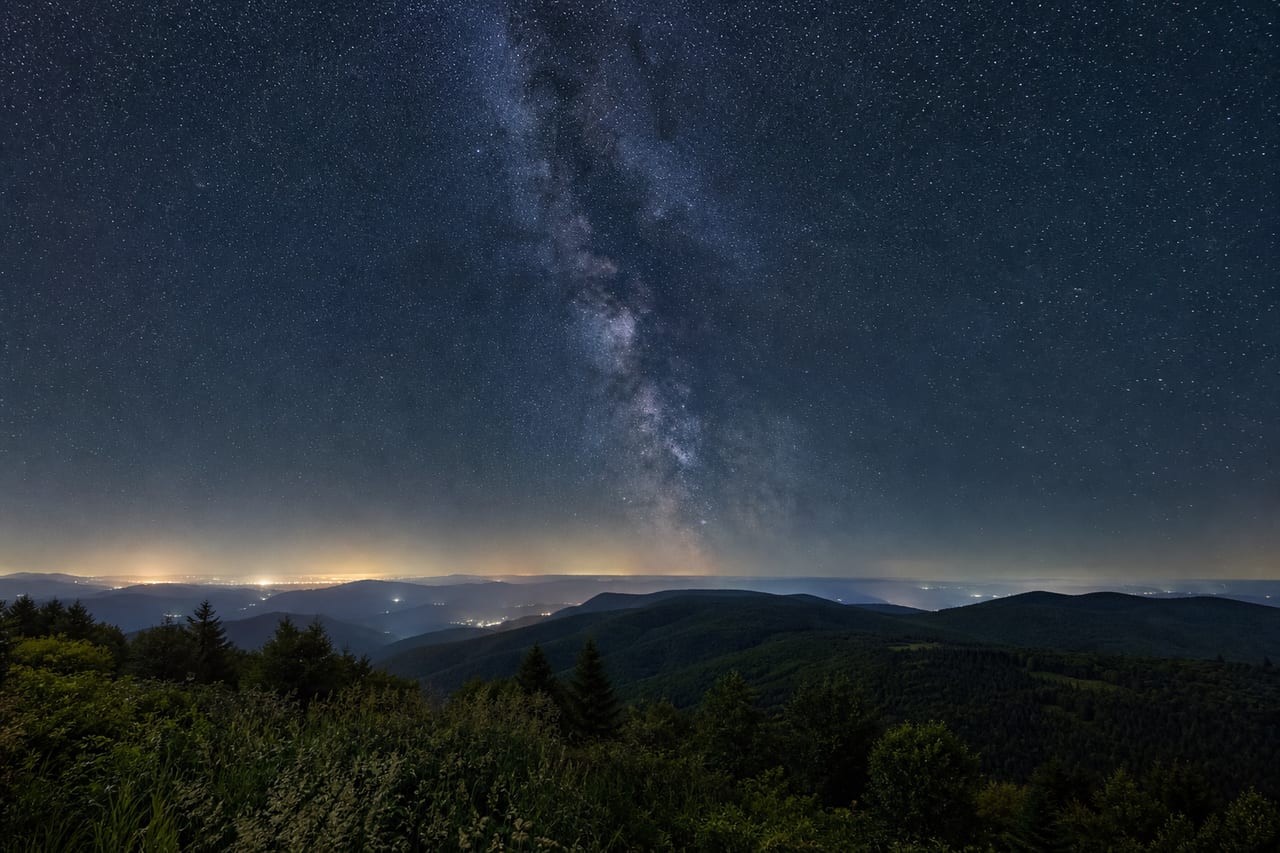
The Hautes-Vosges are among the least light-polluted areas in the Grand Est region. In summer, at 1,000 m altitude on the ridges, the Milky Way is visible to the naked eye on a clear night. Here is how to make the most of it without specialist equipment.
Why the Vosges for stargazing
Light pollution from cities washes out the night sky. In the Hautes-Vosges, the forest massif absorbs stray light from the valleys, and the altitude reduces the depth of atmosphere you are looking through. The result: a noticeably darker sky than in the lowlands, with thousands of stars visible where a city shows only a few dozen.
The Vosges ridges have another advantage: an unobstructed 360° horizon, with no obstacles for low-sky observations.
The best spots
Le Hohneck (1,363 m)
The third highest summit in the Vosges has a broad horizon, but this is not an improvised night outing. From Col de la Schlucht, the official return walk is 7.7 km and takes about 2.5 hours. Shorter approaches exist from the Route des Crêtes when their access is open; check the signs on the day. Bring proper walking shoes, a dependable head torch and a windproof layer.
To plan the approach hike, see our Hohneck hiking guide.
La Route des Crêtes
Running for about 70 km between Cernay and Sainte-Marie-aux-Mines, the Route des Crêtes serves several viewpoints. In the evening, use only a marked parking area that is visibly open; do not enter closed lanes or walk onto the high meadows. Access can change because of weather, works or wildlife-protection measures, so check the signs on the day.
Mountain lakes
Lac de Blanchemer (984 m) can produce attractive reflections on a calm night, but it is suitable only for early-evening viewing. From 1 May to 30 September, parking is banned in every car park at the site between 11:30 pm and 4:30 am, except for anglers holding a valid permit. Leave before 11:30 pm and keep away from the fragile peat-bog areas.
Around La Bresse
The village is surrounded by heights accessible on foot from chalets on the outskirts. A 20-30 minute uphill walk towards the surrounding ridges is enough to leave the valley lighting behind. Chalets in La Bresse at altitude sometimes have open terraces with clear views, removing the need for any night-time travel.
When to go
June to September: the Milky Way
The Milky Way is visible from June to September. In summer, the galactic core (its brightest, densest section) reaches its highest point in the southern sky after midnight. Best conditions: new moon (completely black sky), stable weather with low humidity, and starting your session after 10:30 pm when full darkness settles.
Mid-August: the Perseids
Every year, Earth crosses the debris stream of comet Swift-Tuttle. In 2026, the International Meteor Organization places the Perseid maximum on 13 August between 02:00 and 04:00 UTC, or 04:00 to 06:00 in mainland France. The new moon on 12 August makes conditions particularly favourable. A rate of 100 meteors per hour is a theoretical maximum under perfect skies; the number you see depends on transparency and how much sky is visible. Lie back with a broad view of the sky rather than staring directly at Perseus.
Tip: choose a night with no moon, or one where the moon sets before midnight, to maximise contrast.
Equipment and preparation
For a successful observation session from the Vosges:
- Warm clothing: even in August, the ridges drop to 10-12°C at night. Jumper, windproof, blanket or sleeping bag.
- Red light torch: red light preserves your eyes’ night adaptation (allow 30 minutes of complete darkness to see faint stars). Avoid white torches.
- Sky-chart app: Sky Map (Android), Star Walk or Stellarium (iOS/Android) let you identify constellations by pointing your phone at the sky. Switch the interface to night mode (red background).
- 7x50 or 10x50 binoculars: optional but rewarding for star clusters, the Andromeda galaxy, or lunar craters.
- Patience: allow 15-30 minutes of eye adaptation after switching off all lights.
Practical notes
Mountain nights are cool whatever the summer season. Let someone know your itinerary before heading into altitude. On the ridges, wind can be strong even when the valley below is calm. Hohneck and Route des Crêtes paths are waymarked but unlit: a head torch is essential for the return.
For a family outing, choose a clear terrace or a viewpoint reached from an authorised parking area without a technical approach. A night walk to Hohneck is for people already comfortable with the route and rocky terrain.
The La Bresse guide, summer edition
Trails, lakes, blueberries and farm inns, in one free PDF.
Your details are used only to process this request. Privacy policy (in French).
Free PDF, no newsletter sign-up.
Frequently asked questions
What are the best spots for stargazing in the Vosges?
The easiest options are officially open viewpoints and marked parking areas along the Route des Crêtes, checked on the day, or a clear terrace outside the valley floor. Hohneck has a broad horizon but requires a genuine night hike. Blanchemer is suitable only early in the evening, before the 11:30 pm parking ban.
When can you see the Milky Way in the Vosges?
The Milky Way is visible to the naked eye from June to September in the Hautes-Vosges. The brightest period is July and August, between 10 pm and 2 am, when the galactic core reaches its highest point above the southern horizon.
What are the Perseids and when should you watch them?
The Perseids are a meteor shower produced by debris from comet Swift-Tuttle. In 2026, the maximum is expected overnight from 12 to 13 August, with almost no moonlight. The theoretical rate can reach 100 meteors per hour under perfect skies; the number actually visible is usually lower.
Do you need a telescope to stargaze?
No. The Milky Way, the Perseids, and the main constellations are all visible to the naked eye. A pair of 7x50 or 10x50 binoculars enriches the experience (star clusters, Andromeda galaxy). A telescope is only useful if you are targeting planets or specific deep-sky objects.
Is stargazing suitable for children?
Yes, with proper preparation: blankets or sleeping bags (ridge temperatures drop to 10-12°C even in August), a red-light head torch to preserve night vision, and a sky-chart app such as Sky Map. The mid-August Perseids are a hit with children from age 5-6.
Is a chalet in La Bresse well located for astronomy?
Yes. Chalets on the outskirts of La Bresse are 5-15 minutes from the ridges, away from town lighting. Several chalets have open terraces or gardens that allow direct observation on clear nights.