
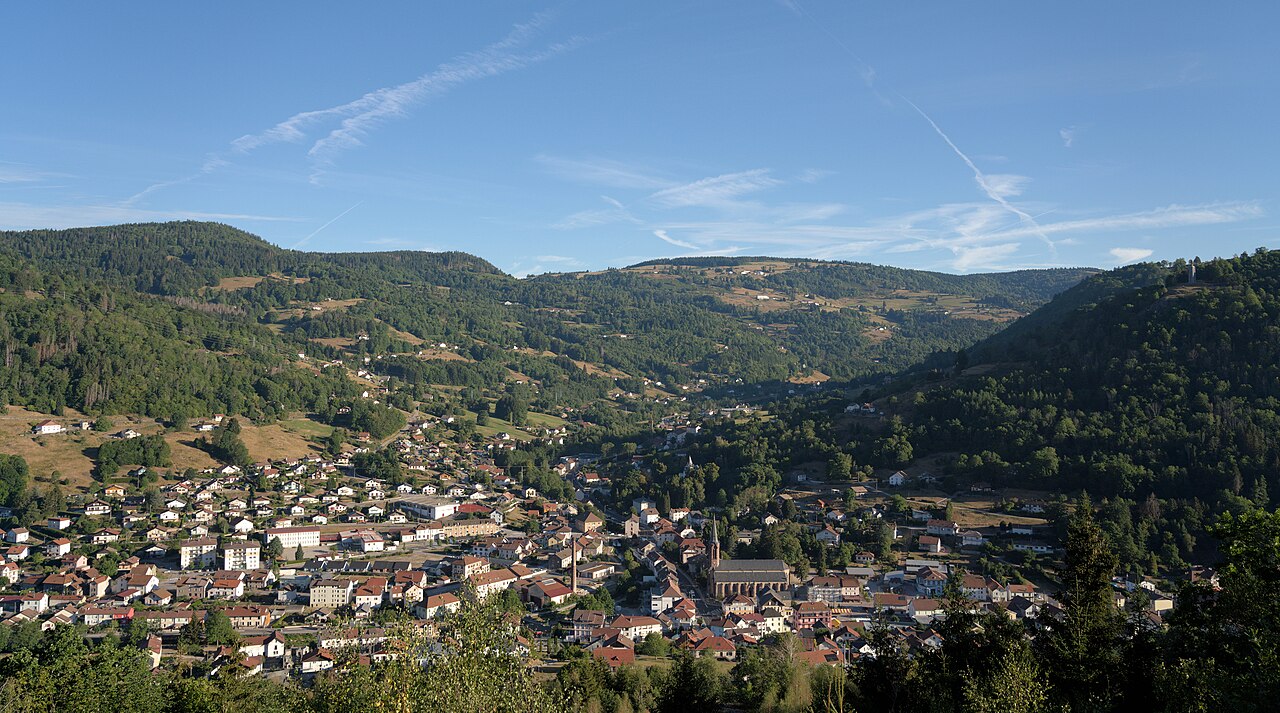
A 10-minute drive from La Bresse, Cornimont embodies the authentic Vosges village: less touristy than its neighbours, intact terroir, inhabitants attached to their region.
Industrial textile heritage
Cornimont lived for nearly a century to the rhythm of its spinning mills and weaving workshops. The textile industry took root in the Moselotte valley from the mid-19th century, taking advantage of the hydraulic power of the rivers to drive the first mechanical machines.
The peak years ran from roughly 1880 to 1950: several textile factories employed a large part of the working population of the town and surrounding villages. The valley produced mainly woollen goods, cotton fabrics and hosiery exported across France and into neighbouring Germany.
Decline began in the 1960s and 1970s with competition from Asian imports and accelerating mechanisation. The last major spinning mill closed in the 1990s, leaving behind imposing industrial buildings as its legacy.
The impact on the townscape is still visible today: surviving factory chimneys, rows of workers’ housing in red brick, former hydraulic channels. Cornimont’s urban fabric can be read directly as that of a Vosges industrial town.
Architectural heritage
Cornimont offers a distinctive built heritage, quite different from tourist resorts:
- Foremen’s houses: constructions in brick and pink Vosges sandstone, more substantial than workers’ housing, with enclosed gardens and ironwork ornamentation. A visible testament to a now-vanished social hierarchy.
- Factory chimneys: several brick chimneys have been preserved, sometimes incorporated into converted residential buildings. They structure the views from the surrounding hillsides.
- Workers’ allotments: the former “factory gardens” survive on the edges of town. These plots, cultivated by working families as an essential food supplement, are still tended by some residents today.
- Workers’ housing estate: a group of collective dwellings built by the textile bosses to house their employees. Sober but coherent architecture, characteristic of Vosges industrial paternalism.
- Chapel of Saint-Nicolas: a place of worship attached to a former mill, built on the initiative of the owners for working families.
A guided tour of this industrial heritage is available through the La Bresse Hohneck Tourist Office.
Hike from Cornimont: the Roches de Travexin
The Roches de Travexin are the flagship excursion from Cornimont:
- Start: Cornimont town centre, car park by the village hall
- Elevation gain: around 250 metres
- Duration: 3 hours round trip at an easy pace
- Difficulty: moderate, yellow-waymarked path, a few rocky sections near the top
- Viewpoint: panorama over the Moselotte valley, Cornimont below, the Grand Ventron chaumes
The route is waymarked and well maintained by the Club Vosgien. The path first crosses a beech forest before opening onto the summit rocks. One walking pole is sufficient; none is needed for most walkers.
Link to the Grand Ventron
Cornimont is one of the natural starting points for the Grand Ventron hike (1,204 m), one of the wildest summits in the Vosges massif:
- Distance from Cornimont: about 12 km round trip
- Elevation: 700 metres
- Duration: 4.5 to 5.5 hours round trip
- Waymarking: red triangles of the Club Vosgien
The ascent passes through the Roches de Travexin before reaching the summit pastures. 360-degree views in clear weather. A loop via the col d’Oderen is possible for variety.
Restaurants in Cornimont
Cornimont is not a gastronomic destination, but a few addresses are worth the detour:
- Brasserie du Bourg: local cuisine, menus between 14 and 20 euros, daily special on weekdays, Vosges specialities at weekends.
- Family pizzeria: simple Italian cooking, quick service, ideal with children. Stone-baked pizzas, homemade pasta.
- Auberge de la Moselotte: outside the town centre, by the river, a more rural setting. Regional cuisine cooked with care, menus between 18 and 28 euros. Booking recommended at weekends.
Prices are generally 15 to 20% lower than in La Bresse for equivalent quality.
Day-to-day services
Cornimont has everything needed for an independent stay:
- Superette and grocer: basic supplies available, open Monday to Saturday
- Bakery: fresh bread and pastries every morning
- Pharmacy: present in the town, standard hours
- GP surgery: on-site medical practice, consultations possible for non-emergency needs during a stay
For a “disconnected” stay with simple shopping and hiking, Cornimont is fully self-sufficient.
Cornimont vs La Bresse: comparison
| Criterion | Cornimont | La Bresse |
|---|---|---|
| Distance from ski area | 10 min | Centre |
| Atmosphere | Reconverted industrial town, authentic | Busy mountain resort |
| Services | Superette, pharmacy, GP | Full range |
| Hikes from town | Roches de Travexin, Grand Ventron | Hohneck, Kastelberg, many more |
| Accommodation price | Slightly cheaper | Standard resort pricing |
| Evening life | Local brasserie, village atmosphere | More bars and restaurants |
Recommendation: Cornimont suits those who want an authentic, affordable base with basic amenities, a few minutes from the ski slopes and main trails. Ideal for a quiet nature holiday without the tourist activity of the big resorts.
The market
Weekly market on Thursday morning, small but quality. Local producers, village vibe, handy for stocking up between two activities.
Base or excursion?
Cornimont can serve as a quiet base for a nature stay: cheaper than La Bresse, calm, quick access to trails and lakes, without the touristy feel of the big resorts.
10 minutes away
- La Bresse Hohneck for skiing and shops
- Lac de Blanchemer for nature
- Saut des Cuves and Gérardmer in 25 minutes
Plan your base in a chalet at La Bresse, just 10 minutes away.
The 2026 La Bresse guide, ready to download
Access, activities, hikes and useful addresses in one free PDF.
Your details are used only to process this request. Privacy policy (in French).
Free PDF, no newsletter sign-up.
Frequently asked questions
What is there to do in Cornimont?
Forest walks, visit the historic spinning mill, access the Grand Ventron hike, weekly market, family restaurants at gentle prices.
How far from La Bresse?
About 10 minutes by car, 10 km along the Moselotte valley.
Is there accommodation in Cornimont?
Yes, gîtes, bed and breakfasts and a campsite. Fewer options than La Bresse, but often cheaper and quieter.
When is market day?
Thursday morning, small but local with very good quality producers.