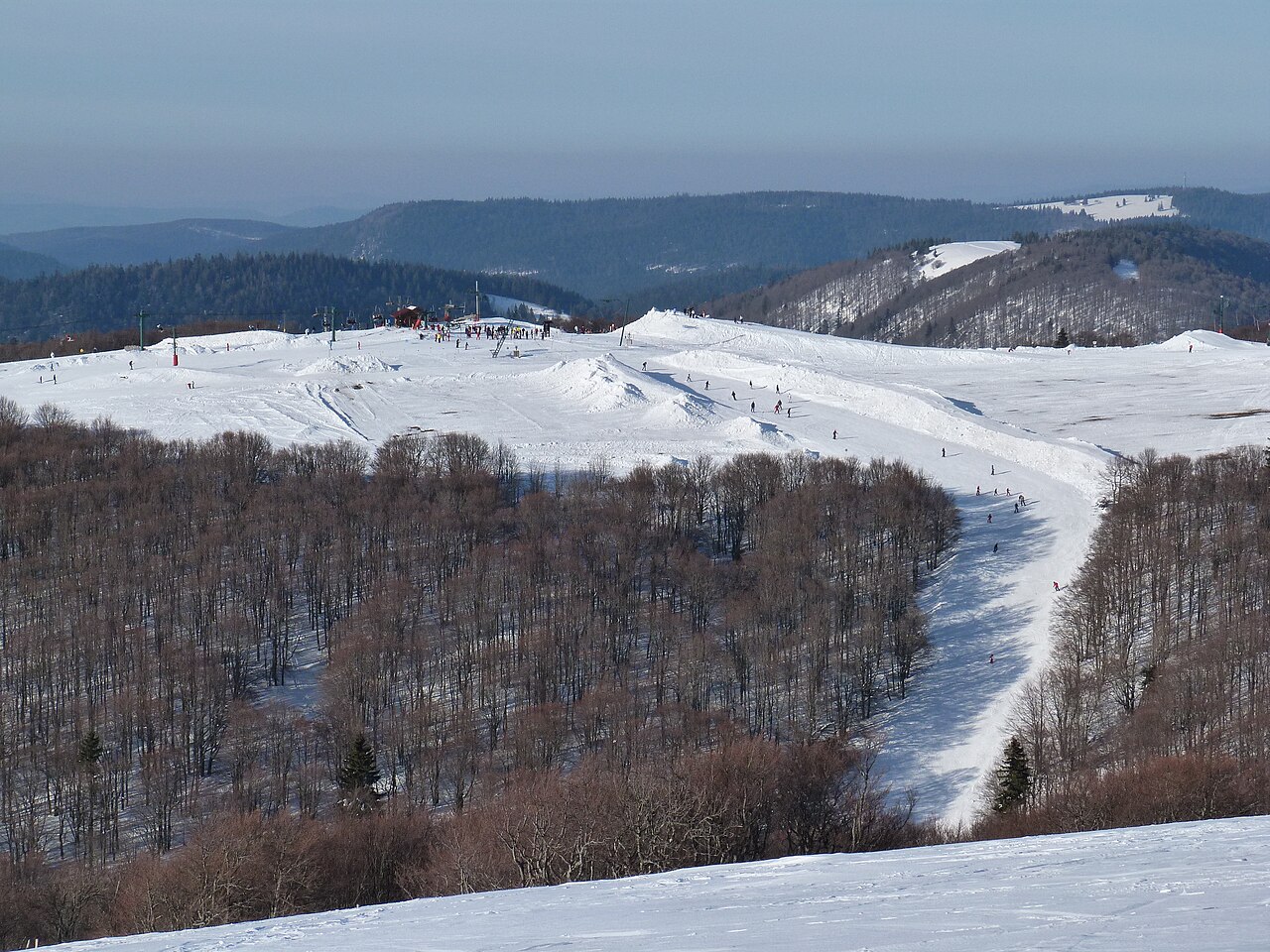
The La Bresse snowpark, on the Vologne sector, is one of the most complete in the Vosges massif. Something for beginners and confirmed freestylers alike.
History of the La Bresse snowpark
The La Bresse snowpark was created in the early 2000s, in response to the growing popularity of snowboarding and ski freestyle in France. In its early days, a few rudimentary kickers and a wooden box made up most of the equipment. The resort gradually invested in professional modules and a team dedicated to daily park maintenance.
Over the seasons, the snowpark structured itself into several zones of increasing difficulty, allowing beginners to progress without being mixed with confirmed riders. Partnerships with local riders and amateur contests helped develop a real freestyle culture around La Bresse, rare for a medium-sized resort.
Today, the snowpark is one of the resort’s flagship attractions for drawing 15 to 30-year-olds and families with teenagers who want more than classic slope skiing.
Freestyle vocabulary: terms to know
For newcomers, the park has its own vocabulary. Here are the terms you will hear:
- Kicker: a jump ramp that propels the rider into the air. Variable size, from mini beginner kickers to big-air ramps several metres high.
- Box: a flat rectangular module to slide along. Allows you to learn the first slides without the risk of a hard fall.
- Flat rail: a flat, horizontal rail, more technical than a box. The rider must maintain lateral balance on a narrow surface.
- Wallride: an angled wall you ride up and back down. Spectacular effect, moderate technique if the approach is well managed.
- Butter: a ground-level move consisting of bending the ski or board to “spread” the snow, without leaving the ground. Accessible from the very first freestyle sessions.
- Jib: generic term for module tricks (rails, boxes), as opposed to jumps (kickers and big air).
- Grab: gripping the board or ski in the air after a kicker.
The zones
- Initiation zone: small foam modules, gentle kickers, learning jumps
- Blue line: boxes, medium jumps, wide rails
- Red line: big air, technical kickers, flat rails
- Boardercross: bumps and banked turns, great fun
Snowboarders and skiers in the park
Contrary to some assumptions, the La Bresse snowpark welcomes roughly a 50/50 mix of snowboarders and freestyle skiers. Coexistence is generally very good, with a well-established culture of mutual respect in the park community.
Priority rules in the queue: as on a regular run, the rider who is descending (or performing their trick) has priority. In the queue for a kicker or rail, wait your turn and do not jump the queue. A “checking” (verbal or visual confirmation that the landing area is clear) before every jump is standard practice.
The park spirit: encouragement (“good run”, applause after a nice trick) is part of freestyle culture. Beginners attempting their first jump are welcomed warmly, especially when they respect the safety rules.
Training camps and freestyle stays
Each season, supervised freestyle stays are organised around the La Bresse snowpark. These camps are generally run by qualified ski instructors with a freestyle specialisation.
Typical format: 3 to 5 days immersion, groups of 6 to 10 riders per instructor, homogeneous level. Morning: technical session with video and analysis. Afternoon: supervised free session in the park. Evening: watching filmed runs, collective feedback.
Period: camps are mainly offered during the February school holidays, which generally coincide with the best natural snow cover and peak snowpark footfall.
Audience: teenagers (12-18 years) primarily, but adult camps also exist. Information from the La Bresse ESF or local freestyle ski associations.
Filming your runs
Video is at the heart of freestyle culture. Here is how to go about it:
Equipment:
- GoPro on helmet: first-person, immersive view, but does not capture tricks well (too close to see rotations or grabs).
- Tripod or pole: placed beside a module, it gives very readable side-on views. Plant the pole in the snow outside the landing zone.
- A friend with a phone: the simplest and often most effective solution for beginners. Stand to the side, film horizontally, zoom slightly.
Best angles:
- Side view of a kicker (to see grabs and rotations)
- Front view of a rail (to see the approach and exit)
- View from below the slope (for boardercross: dynamic and speed)
Video analysis: watching your runs on replay allows you to correct position errors, poor takeoffs or landings that you cannot perceive from the inside. Freestyle instructors use video systematically in their courses.
Recommended kit
- Helmet compulsory or strongly advised depending on the zone
- Back protector for big module sessions
- Twin tip skis or snowboard to handle switch landings
- Clear goggles for the wooded sections
When to hit the park
Modules are maintained daily early in the morning. Best snow and clean modules first thing. Crowds build in the afternoon.
The best snow for the park
Not all snow types are equal for freestyle. The ideal snow is cold and shaped by the piste machines: compact, lightly packed, without being icy. It provides good grip on modules and predictable landings.
Spring snow (often wet and heavy, especially in the afternoon) is less pleasant for the park: modules deteriorate faster, rails become unpredictably slippery and snow collects as slush in the landing areas. If possible, prefer morning sessions late in the season.
Fresh powder after a snowfall is spectacular for photos but complicates the park: modules disappear under snow, rails are hard to spot and landing zones are unpredictable. Wait a day for the piste machines to clean the park.
Recovery after freestyle
A 2 to 3-hour park session works muscles often neglected in classic alpine skiing:
- Legs (quadriceps, hamstrings) for landings and butters
- Core and lower back for maintaining balance in the air and on modules
- Wrists and forearms for repeated grabs
- Ankles intensively used on rails
Active recovery:
- Light walk or stroll in the village before returning
- Stretching targeting quadriceps, hamstrings and calves (10 minutes is enough)
- Hot bath or sauna at the chalet within the hour: muscle relaxation and soreness prevention
- Cold bath (or fresh snow on the legs) alternating with heat for riders familiar with this recovery method
Eat well after a session (protein and carbs) and sleep well: the body repairs micro muscle damage overnight.
Contests and events
Several amateur contests per season, girls’ freestyle day, clinics with local coaches. Programme on the resort website.
How to progress
- Start on small modules even if you ski well
- Aim for the initiation zone to learn jib basics
- Film your runs to spot your errors
- Take an ESF freestyle course for fast technical gains
Combine
Morning snowpark, lunch at the mountain chalet, afternoon on the big Hohneck runs, and night skiing in the Vologne sector to cap a big day.
Stay at our chalet, 5 min from the Vologne chairlift.
The La Bresse guide, winter edition
Ski area, après-ski activities and good addresses, in one free PDF.
Your details are used only to process this request. Privacy policy (in French).
Free PDF, no newsletter sign-up.
Frequently asked questions
Do you need a special pass for the snowpark?
No, the snowpark is included in the standard resort pass. No extra charge. Helmet strongly recommended (or compulsory in some zones).
Is it open to beginners?
Yes, the initiation zone offers foam modules, gentle kickers and learning jumps. Ideal for first sessions.
Are there lessons?
Yes, ESF and independent instructors offer freestyle classes for children and adults. Big progress in a few sessions.
What equipment is essential?
Helmet (compulsory or strongly recommended), back protector for big modules, twin tip skis or board. Light goggles for wooded zones.