
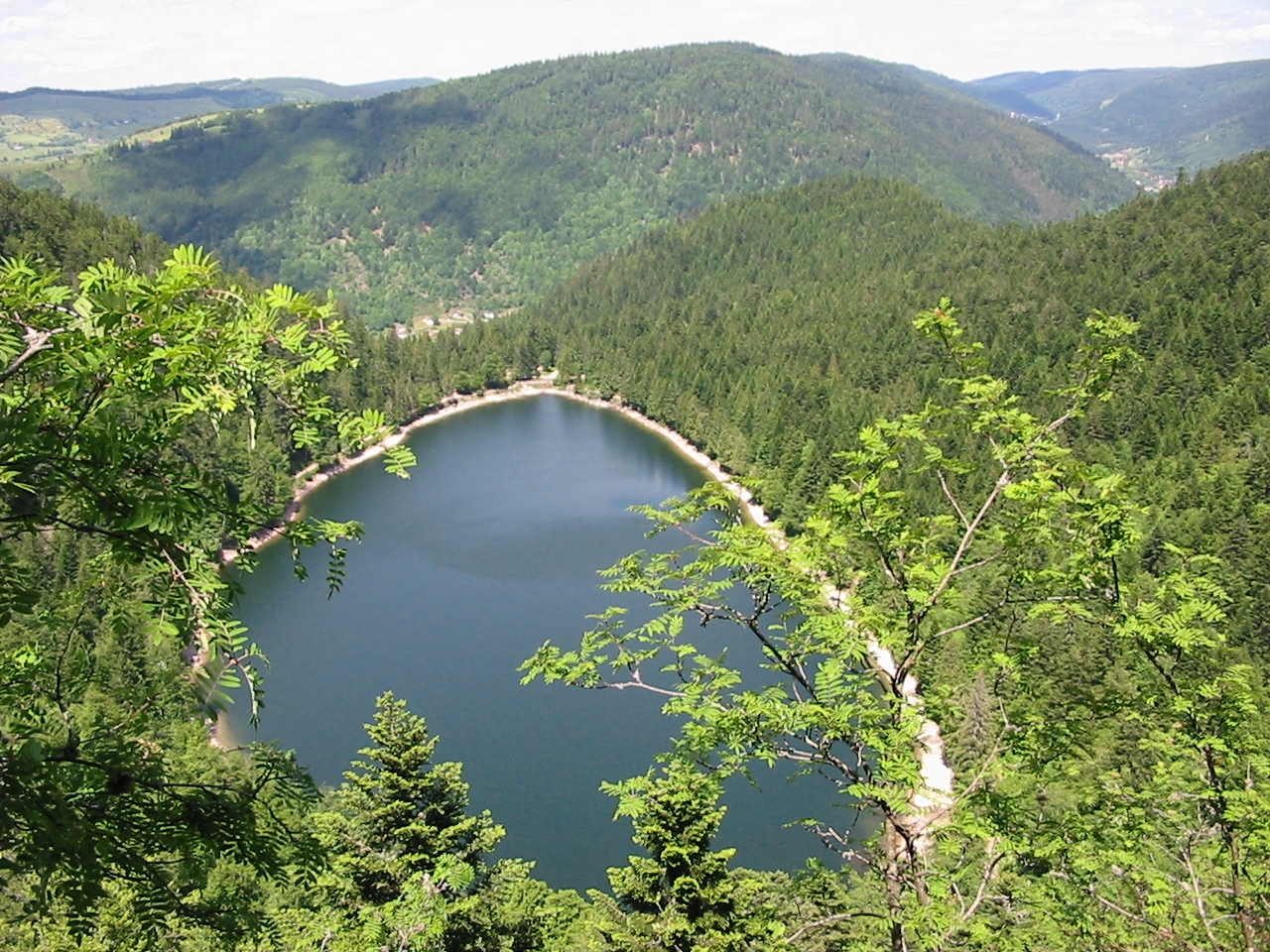
Lac de Lispach is a glacial lake at 912 m altitude on the commune of La Bresse, in the Hautes-Vosges. What makes it stand out: roughly half of its 10-hectare surface is occupied by a floating peat bog, known locally as the « ténine ». The site is classified as a Sensitive Natural Area (ENS), listed under Natura 2000, and sits within the Regional Natural Park of the Ballons des Vosges. The walk is entirely free, rated very easy, and follows a signposted educational trail of 4.5 km.
What you will see
The first impression when you arrive at the lakeshore is the landscape itself. The bog spruce forest (dense spruces growing on peat), the dark mirror of the water, and the ténine floating in silence give the place a strikingly « boreal » atmosphere: it feels like northern Canada, yet it is only 9 km from the village.
The educational trail follows the shoreline and crosses wooden boardwalks on stilts built above the bog. These platforms let you observe the ténine at close range without setting foot on it: the ground is spongy, the sphagnum mosses are fragile, and some areas can collapse underfoot.
Interpretation panels along the route explain how bogs form, their ecological role (carbon storage, water regulation), and the life they sustain.
Remarkable plants
- Sundew (Drosera): a protected carnivorous plant with 3 recorded varieties. Its sticky, hair-covered leaves trap insects to compensate for the nitrogen-poor environment.
- Sphagnum mosses: capable of absorbing up to 36 times their weight in water, they are the raw material of peat.
- Cranberry: a low-growing plant with red berries, extremely rare outside Vosges bogs.
- Bog spruce forest: spruces adapted to acidic, waterlogged conditions.
Roughly 250 plant species have been documented on the site overall.
Wildlife to look for
The Capercaillie (a large woodland grouse) frequents the area around the lake, particularly in its display zone. Stay on marked paths and do not approach it. The Cranberry fritillary is a rare butterfly whose larvae feed exclusively on cranberry: it is entirely dependent on this ecosystem.
Getting there
By car: from La Bresse village centre, follow the Route de Lispach (signs for « Domaine Skiable de Lispach » or « Vallée du Chajoux »). Allow 10 to 12 minutes. Free parking at the foot of the slopes, facing the lake.
By bus: a bus service runs to the area during the tourist season (check timetables with the La Bresse tourist office).
The trail is marked with a yellow ring blaze. Duration: 1h30. Distance: 4.5 km. Elevation gain: minimal. Official rating: very easy.
GPX tracks are available for download on the Tourisme Vosges website (search for « Sentier pédagogique du lac de Lispach et de la Ténine »).
When to visit
The walk is accessible from May to October. The best window falls between June and September: vegetation is in full growth, insects are active, and the sundew is clearly visible.
Outside summer, the site remains accessible (snowshoes possible in winter), but some sections can be muddy after rain.
Fishing is permitted from 1 May to 1 November (perch, pike, carp, roach, tench) with a valid permit.
Tips before you go
- Never leave the marked trail or the boardwalks: the ground can be unstable near the bog.
- Do not pick protected plants (sundew, cranberry).
- Swimming, fires and camping are all forbidden. If you see smoke, embers or recent fire remains, read our guide to preventing and reporting a fire in the Vosges and call 18 or 112 if there is an immediate danger.
- Wear closed, waterproof shoes if the ground is wet.
- Binoculars are recommended for observing wildlife at a safe distance.
Combine your visit
Lac de Lispach is an easy half-day outing. Here are natural combinations from La Bresse:
- The Route de Lispach passes right by Wiidoo Gliss (all-season toboggan run): ideal before or after the walk, especially with children.
- For a broader picture of the Vosges bogs, Vosges peat bogs: 5 unusual walks lists other sites in the massif.
- Winter sports at Lispach (alpine skiing, cross-country, toboggan) are covered in Domaine de Lispach: same place, different season.
- For a full day in nature around La Bresse, see Things to do in La Bresse and Hikes with children in La Bresse.
- More ambitious hikers can continue to the Col de la Schlucht or Hohneck summit hike.
Use our La Bresse holiday chalets as your base to explore the area.
Key takeaways
Lac de Lispach is one of the very few places in mainland France where you can observe a floating peat bog, for free, on a purpose-built educational trail. The 4.5 km walk is suitable for all ages. The site is protected at several levels (ENS, Natura 2000, Ballons des Vosges Regional Natural Park): the rule is simple, keep to the marked paths and respect the signs.
The La Bresse guide, summer edition
Trails, lakes, blueberries and farm inns, in one free PDF.
Your details are used only to process this request. Privacy policy (in French).
Free PDF, no newsletter sign-up.
Frequently asked questions
Where is Lac de Lispach located?
Lac de Lispach is on the commune of La Bresse (Vosges, 88250), approximately 9 km from the village centre via the Route de Lispach. By car from the village, allow around 10 to 12 minutes. Free parking is available at the foot of the ski slopes, directly facing the lake.
Can you swim in Lac de Lispach?
No. Swimming is strictly forbidden. The site is classified as a Sensitive Natural Area (ENS) and is part of the Natura 2000 network: the ecosystem is extremely fragile. The water is cold, and the floating bog makes the area hazardous off the marked paths.
How long does the walk around the lake take?
The marked educational trail covers 4.5 km and takes about 1h30. The official difficulty rating is 'very easy', with almost no elevation gain. Suitable for families with young children, and partly accessible to people with limited mobility on the boardwalk sections.
What is the floating bog (ténine)?
The 'ténine' is a peat raft that covers roughly half the lake surface, floating directly on the water. It formed over thousands of years as sphagnum mosses accumulated and compressed into peat. These mosses can absorb up to 36 times their own weight in water. Wooden boardwalks on stilts allow visitors to observe the ténine up close without stepping on it.
What wildlife and plants can you see?
The site is home to sundew (a protected carnivorous plant, 3 varieties), cranberry, sphagnum mosses, and a bog spruce forest. Wildlife includes the Capercaillie (a rare woodland grouse, nesting area nearby), the Cranberry fritillary butterfly (whose larvae feed exclusively on cranberry), and around 250 documented plant species.
Is there an entry fee?
No. Access to the lake and the educational trail is completely free. Fishing is allowed from 1 May to 1 November with a valid fishing permit (see peche-labresse.fr for details). There is no entrance ticket.